
25 July 2026
"Mailchimp vs Constant Contact: Which Is Better for Small Business Email Marketing?"
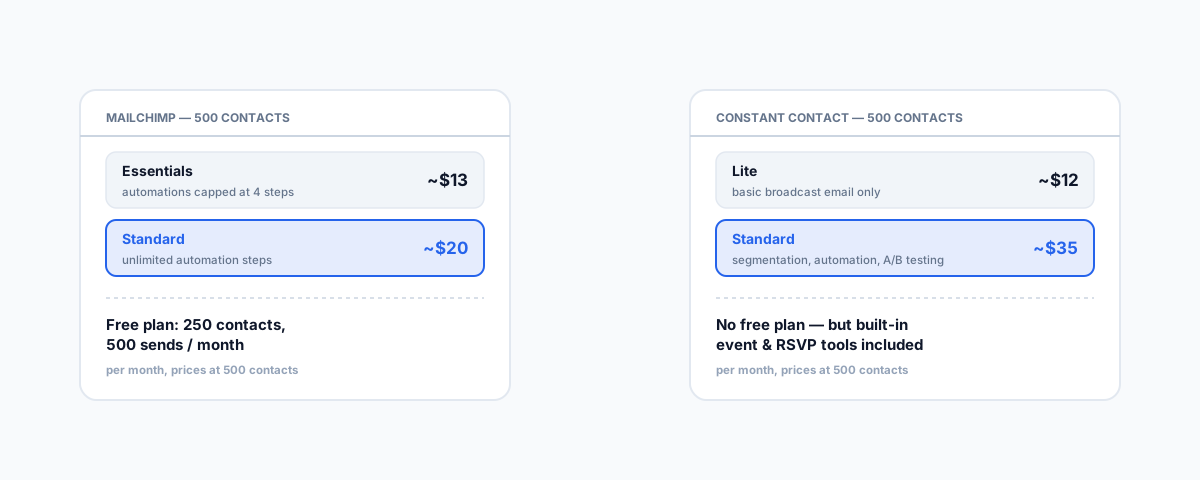
Mailchimp's free plan covers 500 contacts; Constant Contact has no free plan at all but bakes in event and RSVP tools Mailchimp doesn't touch. What each platform actually costs at 500 contacts, where Constant Contact still wins, and how to decide.
Most small businesses end up on Mailchimp or Constant Contact for the same reason: it's whichever one a previous employee, a web developer, or a "best email marketing tools" listicle happened to set up first. Both are capable platforms that have been around for two decades, and either one will get a newsletter out the door. The real question worth answering before you commit — or before you keep paying for whichever one you inherited — is which one actually fits how your business markets itself, because the two are built around genuinely different assumptions about what a small business needs from email.
What Mailchimp Actually Costs and Includes
Mailchimp's own pricing page lists a free plan capped at 250 contacts and a maximum of 500 sends a month — tight enough that most active businesses outgrow it within the first few campaigns, not a genuine long-term option the way it once was. From there, Essentials starts at roughly $13 a month at the 500-contact mark and includes 3 user seats and 3 audiences, but automations are capped at four linear steps — a welcome email or an autoresponder, not a branching customer journey. Standard, from around $20 a month at the same contact count, removes that cap entirely: unlimited multi-step automations, predictive and behavioural segmentation, generative AI content tools, and multivariate testing. Premium, aimed at larger lists, starts around $350 a month at 10,000 contacts and adds unlimited seats, priority phone support, and a dedicated onboarding specialist. The pattern worth noticing is that Mailchimp's real automation and segmentation power sits behind the Standard tier, not the entry-level plan — the cheap option and the capable option aren't the same plan.
What Constant Contact Actually Costs and Includes
Constant Contact drops the free tier altogether — there's a trial with no credit card required, but no permanent free plan to fall back on. Its three tiers, Lite, Standard, and Premium, run roughly $12, $35, and $80 a month respectively at 500 contacts, with Standard adding segmentation, automation, and A/B testing, and Premium layering on more advanced automation, custom reporting, and SEO tools. Pricing scales with list size on all three, the same as Mailchimp. What Constant Contact includes that Mailchimp doesn't touch at any tier is a genuine built-in event marketing module — creating and promoting events, collecting RSVPs straight into a marketing list, selling tickets, sending automatic reminders, and tracking attendance and post-event stats in one dashboard, without a separate app or integration. Nonprofits also get a real discount here: 30% off with a 12-month subscription directly, and up to 50% through TechSoup for eligible organisations.
Where Constant Contact Still Wins
This is the part a straight "Mailchimp is better" take usually skips. If your business runs on events — fundraisers, open days, community classes, association memberships, anything where an RSVP list matters as much as an email list — Constant Contact's event tools are a genuine built-in capability that would otherwise mean bolting Eventbrite or a similar tool onto Mailchimp and manually syncing the two lists. Nonprofits get materially better pricing on Constant Contact than the standard commercial rate either platform charges. And for a business that just wants to send a plain, well-designed newsletter without ever touching an automation builder, Constant Contact's simpler, more linear interface is genuinely less overwhelming than Mailchimp's broader (and, at the higher tiers, genuinely complex) feature set.
How to Actually Decide
Start from what your business actually runs, not brand familiarity. If email is mostly newsletters and broadcast promotions with light automation, either platform will do the job and price is the deciding factor — Constant Contact's Lite tier undercuts Mailchimp's Essentials slightly at low contact counts, though Mailchimp's free tier still wins for a business under 250 contacts sending occasionally. If your marketing depends on multi-step automation — abandoned cart flows, post-purchase sequences, behavioural segmentation — Mailchimp's Standard tier does more than Constant Contact offers at any price point; our guide to Mailchimp automation for small teams covers what's actually worth building once you're on that tier. If you're running an online store rather than a services or events business, it's also worth reading our comparison of Klaviyo vs Mailchimp for Shopify before committing to either — ecommerce-specific automation is a different comparison again. And if events, RSVPs, or nonprofit pricing are central to how you operate, Constant Contact's built-in tooling is worth the otherwise-higher entry price rather than working around Mailchimp's lack of it.
Getting Help
Picking a platform is the easy part — the time actually gets spent building segments that reflect how customers behave, automations that trigger on the right event, and templates that don't need rebuilding every campaign. Our Email Marketing service sets up whichever platform actually fits your business, migrates your existing list and history across cleanly if you're switching, and builds the automations so the platform earns its monthly cost instead of sitting half-configured.