
23 July 2026
The 2026 Verizon Outages: What Small Businesses Should Actually Do About Carrier Dependence
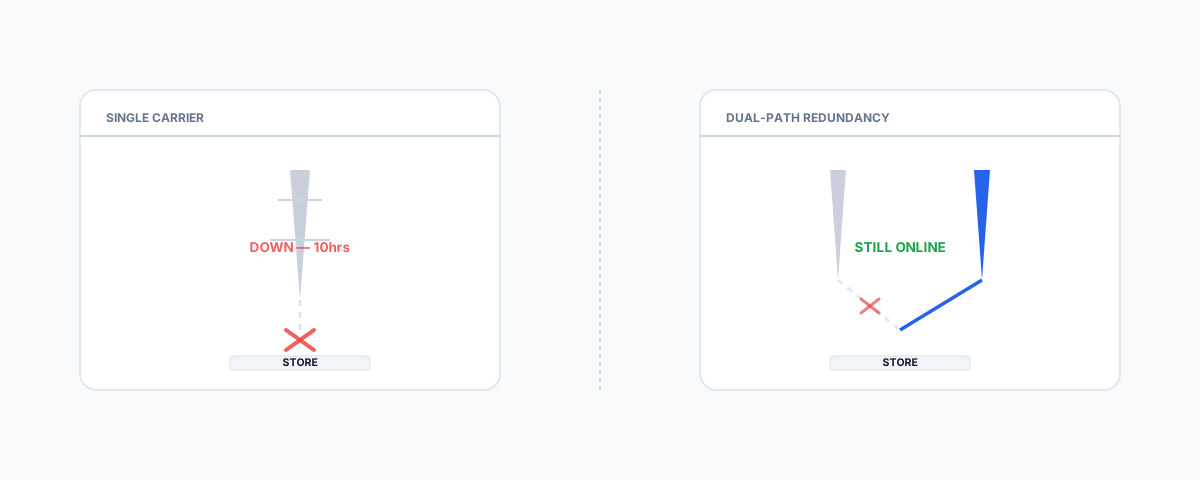
A 10-hour nationwide Verizon outage in January 2026 and a second fiber-cut outage in May knocked out calls, texts, and data for millions. Neither was an attack — just a software bug and a cut cable. What that means for any business relying on a single carrier, and the redundancy options that actually work.
On January 14, 2026, Verizon Wireless went down across the United States for more than 10 hours, cutting off calls, texts, and data for over 1.5 million customers. Phones sat stuck on SOS-only mode in the middle of a business day. It happened again, on a smaller scale, on May 5, when fiber cuts in Western Pennsylvania knocked out service across a region. Neither event was a hack, a cyberattack, or anything exotic — one was a software bug, the other was a physically severed cable. That's the part worth sitting with: the failure modes were mundane, which means they aren't unique to Verizon, and any business built around a single carrier is carrying the same risk whether or not it's ever been tested.
What Actually Happened
The January outage traced back to a software issue introduced during a feature update to Verizon's 5G Standalone (5G SA) core network, according to Verizon's own account of the incident — not a cyberattack, the company was explicit about that. The scale was real: reports spiked past 130,000 on outage-tracking sites at the peak, and the disruption to 911 calling was serious enough that the FCC's Public Safety and Homeland Security Bureau opened a formal inquiry, specifically asking the public for information on how the outage affected emergency calling. Verizon offered a $20 account credit to affected customers. The May outage was smaller and more mundane still — physical fiber cuts in Western Pennsylvania — but it landed less than four months later, which is the detail that turns "freak event" into "this is just what happens sometimes."
Why the Boring Cause Is the Important Part
It would be easy to read this as a Verizon-specific problem and move on. That's the wrong takeaway. A software bug shipped during a routine update, and a physically damaged cable, are exactly the kind of failures that happen to every carrier, not a defect unique to one company's network. If your business runs on a single mobile carrier for calls, card payments, or connectivity, the actual risk isn't "Verizon is unreliable" — it's that you have a single point of failure, and the two most common ways it breaks (a bad software push, a cut line) are things no carrier is immune to.
What Redundancy Actually Looks Like
The instinct after an event like this is to look at your carrier contract and check the SLA. Don't stop there — here's the part most advice skips: a typical carrier SLA credit refunds you for the service you didn't get, not the business you lost while it was down. It's a cap on the carrier's liability, not a safety net for yours. If connectivity actually matters to your revenue, the fix is redundancy, not a bigger credit:
- Dual-SIM or eSIM on mobile devices — carrying an eSIM profile on a second carrier alongside your primary physical SIM means a staff member's phone can fail over to a different network instead of going dark entirely during an outage.
- Dual-modem setups for fixed locations — a store, office, or venue that depends on connectivity for card payments or point-of-sale can run two modems on two different carriers simultaneously, rather than one connection with no fallback.
- SD-WAN failover — for a business running voice or transaction systems over the internet, SD-WAN can switch between connections in under a second, so a call or a payment session doesn't drop even if one path goes down mid-transaction.
- A genuinely separate second path, not just a second plan — the redundancy only counts if the backup doesn't share the same failure point as the primary. Two SIMs from the same carrier, or two lines that both run through the same local exchange, aren't real redundancy.
Sizing This to Your Actual Risk
Not every business needs a fully redundant SD-WAN setup — that's a real cost, and it should match what an outage actually costs you. A retail counter that can't take card payments for ten hours has a concrete number attached to that risk; an office that can work offline for a morning and catch up later does not need the same investment. The useful exercise is simple: work out what a half-day outage would actually cost your business in lost transactions, missed calls, or stalled operations, and size your redundancy spend against that number rather than against a vague sense that "outages are bad."
The Honest Bottom Line
Neither the January nor the May outage was caused by anything dramatic, and that's exactly why they're worth planning around rather than filing away as bad luck that happened to someone else's carrier. A software bug and a cut cable are ordinary failure modes that can hit any network, and the businesses that came through those ten hours without missing a beat were the ones that already had a second path in place before they needed it — not the ones with a better contract to point to afterward.