
22 July 2026
Abandoned Cart Recovery for Shopify and WooCommerce: What Actually Gets Emails Opened and Carts Finished
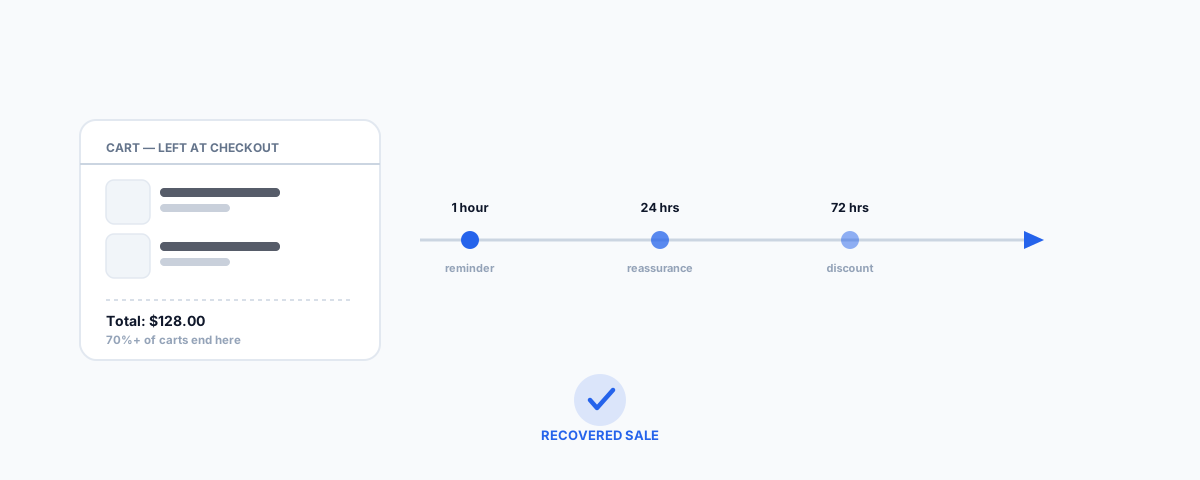
Just over 70% of online carts are abandoned before checkout. What Shopify and WooCommerce actually give you out of the box, the email and SMS sequence that recovers the most sales without training customers to expect a discount, and how to set it up properly on either platform.
For every ten shoppers who add something to their cart, roughly seven leave without paying. That is not a sign your store is broken — it is the normal, well-documented baseline for online retail, and it means the highest-leverage thing most stores can do to grow revenue is not more traffic, it is recovering a slice of the traffic they already paid to get. The good news is that this is one of the more mechanical wins in ecommerce: the platforms already log who abandoned what, and a well-built recovery sequence reliably brings a meaningful share of them back without discounting your way to a thinner margin. Here is what actually works, and how it differs on Shopify versus WooCommerce.
Why This Happens, and Why It's Not Really About Your Store
The Baymard Institute's ongoing research, which aggregates dozens of studies over more than a decade, consistently puts the average documented cart abandonment rate at just over 70%. The reasons are remarkably stable year over year: unexpected costs revealed at checkout — shipping, taxes, fees the customer didn't see on the product page — are consistently the single biggest driver, followed by being forced to create an account before paying, and a checkout process that simply takes too long or asks for too much. None of that means your product or your pricing failed to convince someone. It usually means the checkout step introduced friction or a surprise, and the customer left to think about it, compare elsewhere, or got distracted — which is exactly the group a recovery sequence is built to bring back.
What Shopify Gives You Natively
Shopify includes abandoned checkout emails on every plan, no app required. Under Settings → Checkout, you can enable automatic recovery emails, and Shopify will send one automatically some hours after a customer leaves checkout with items in their cart and contact details captured. It works, and it costs nothing extra — but it is also a single, generic email with limited customisation of timing or sequence. That is the ceiling of the native tool: fine as a baseline, not enough if cart abandonment is a serious revenue lever for your store.
What WooCommerce Needs an Add-On For
WooCommerce has no equivalent built in — cart and checkout abandonment tracking is not part of core WooCommerce, so this is a plugin decision from day one. Dedicated options such as CartFlows, Retainful, or WooCommerce's own Cart Abandonment Recovery extension track abandoned carts and trigger a configurable email sequence, and most support coupon codes and basic segmentation. If your store already runs email marketing through Klaviyo — which we cover in our guide to moving from Mailchimp to Klaviyo— Klaviyo's own abandoned cart flow connects directly to WooCommerce via its plugin and is generally a stronger, more flexible option than a checkout-only plugin, since the same platform then also handles your broader email marketing.
The Sequence That Actually Recovers Sales
A single email is a start; a short, timed sequence recovers meaningfully more. The pattern that performs consistently across stores, regardless of platform:
- Email one, within an hour — a plain reminder, no discount. Show the exact items left in the cart with images, and nothing else. Most recovered sales come from this email alone, because a lot of abandonment is simple distraction, not a pricing objection.
- Email two, at 24 hours — add a light nudge: answer a likely objection (free returns, delivery timeframe, a security reassurance at checkout) rather than jumping straight to a discount.
- Email three, at 48–72 hours — this is where a discount code, if you're going to use one, earns its keep. Keep it modest and time-limited, because a customer who has seen two free reminders and now gets 15% off has been taught that waiting pays — a real cost if you run this sequence on every cart, every time.
- SMS or WhatsApp as a fourth touch — for higher-value carts, a text reaches a phone that an inbox often doesn't, particularly if the same channel already handles order updates. Our guide to integrating WhatsApp and SMS into a business phone system covers the messaging side of this if you haven't set it up yet.
The Discount Trade-Off, Honestly
Every abandoned cart tool wants you to lead with a discount, because it is the easiest thing to configure and it does lift open and conversion rates in isolation. The honest cost is that a blanket discount on every recovery email trains your customer base to abandon carts on purpose, waiting for the code — which is a real, measurable margin leak on a store with repeat buyers. The fix is not to skip discounts entirely, it's to hold them back to the final email in the sequence, so the first two touches do the recovery work on reminder and reassurance alone, and the discount is reserved for the genuinely price-sensitive tail rather than given away to everyone who simply got distracted.
Setting It Up Without Overbuilding It
On Shopify, turn on the native abandoned checkout email first — it's free and immediate — then evaluate whether a dedicated app (many stores use Klaviyo here too, given its native Shopify integration) is worth it once you know your cart volume and average order value. On WooCommerce, pick one plugin rather than stacking several that all track the same abandonment event, since duplicate emails from competing tools is a fast way to annoy exactly the customers you're trying to win back. Whichever platform, check your analytics after 4–6 weeks — the recovery rate should be visible in the app's own reporting — before tuning the timing or discount further.
Getting Help
Recovering abandoned carts properly is a small, well-scoped project: pick the right tool for your platform, build a three-email (or four-touch) sequence instead of relying on one generic email, and hold the discount back until it's actually earning its keep. Our Shopify Integrations service sets this up end to end, alongside the rest of your store's checkout and app stack. Seven in ten carts leaving is the industry norm — how many of those seven you get back is the part actually within your control.