
14 October 2026
AI Tools for Real Estate Investors: What's Actually Useful, and Where the Hype Outruns the Data
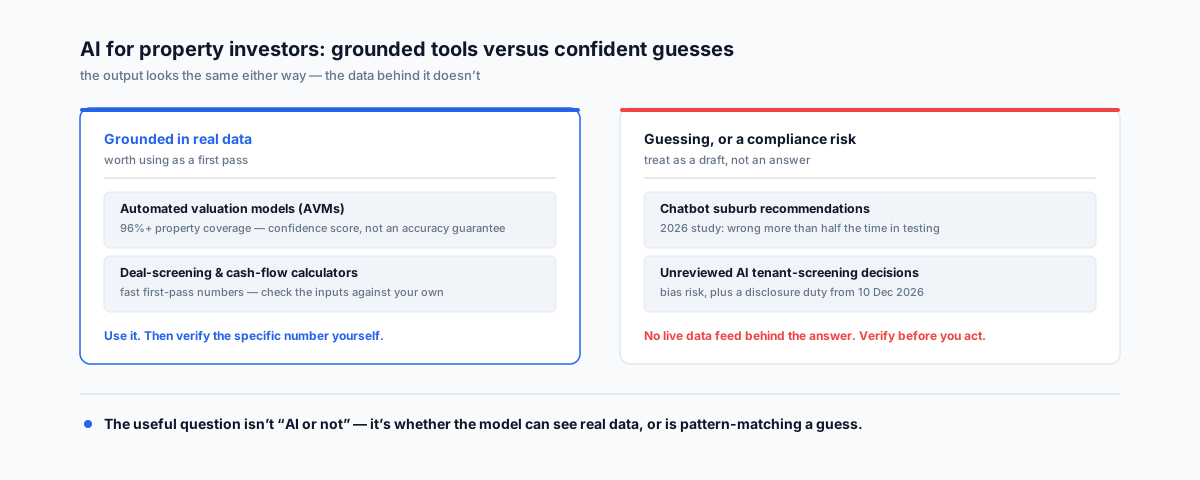
AI is being pitched for every stage of property investing — suburb picks, valuations, deal screening, tenant scoring, lease review. A 2026 study found ChatGPT's suburb recommendations were wrong more than half the time. Here's what's genuinely useful, and what to verify yourself before you rely on it.
Every property platform, proptech startup and banking app now has an AI feature bolted onto it — pick a suburb, score a deal, screen a tenant, summarise a lease. Some of that is genuinely useful. Some of it is a chat window wrapped around a guess.
The useful distinction isn't "AI versus no AI." It's where the model is grounded in actual data it's allowed to see, and where it's just a confident-sounding language model filling gaps with whatever's statistically plausible. Those produce very different outputs, and property investing is exactly the kind of domain where a plausible-sounding wrong answer costs real money.
Asking A Chatbot To Pick A Suburb
This is the one to be most sceptical of, and there's now a specific data point for why. MCG Quantity Surveyors tested ChatGPT by asking it to recommend investment-grade suburbs around Australia on a $1 million budget. Coverage of the study found the recommendations failed fact-checking more than half the time — the model consistently favoured units over houses, prioritised rental yield over long-term capital growth, and in some cases invented or ignored relevant data. It was genuinely good at one thing: naming infrastructure-led growth corridors like Western Sydney Airport, Brisbane's Cross River Rail, and Melbourne's new Footscray Hospital.
That's the pattern worth remembering. A general-purpose chatbot has no live feed of sale prices, vacancy rates, or supply pipelines — it's pattern-matching against training data that's already out of date the moment a market moves. It's a reasonable research assistant for explaining a concept, summarising a planning scheme, or pointing you toward growth drivers you hadn't considered. It's a poor substitute for a specific number, and a worse substitute for "where should I buy."
What Automated Valuations Actually Tell You
The AI tool most investors already use without thinking of it as AI is the automated valuation model (AVM) behind the instant estimate on a bank app or property portal. Cotality (formerly CoreLogic) publishes an AVM product page describing coverage of more than 96% of Australian residential properties, built from transaction data and refined with machine learning, with performance and accuracy reported monthly to support lenders' regulatory requirements.
The detail worth reading past the marketing: every AVM estimate comes with a confidence score, and that score measures how much reliable data exists for that specific property — not how accurate the dollar figure is in market terms. A high-confidence estimate on a standard three-bedroom house in a suburb with twenty recent comparable sales is a reasonable starting point. A low-confidence estimate on a unique property with no recent local sales is closer to a guess with a number attached. Lenders know this, which is why an AVM triggers a full valuation rather than replacing one once the loan size or property type crosses a threshold. Treat it the same way — a fast first filter, not the number you base an offer or a capital gains calculation on.
Deal-Screening And Cash-Flow Tools
A newer category of tools runs the actual investment maths for you — deal scores, automatic financial modelling, ROI projections, red flags for overcapitalisation. They're useful for the same reason a spreadsheet template is useful: they get you from zero to a first-pass number fast, and they're consistent about which inputs they use every time.
The catch is that they're only as good as what you feed them, and vendors describing their own accuracy are not a neutral source. Run the numbers from a deal-screening tool against your own assumptions on vacancy, interest rate movement, and the actual lease terms before you treat the output as a decision rather than a starting point. Once a property clears that first filter, the ongoing financial side — rent reconciliation, cash flow tracking, trust accounting — is a different job to deal screening, and it's one we've covered in more detail in Baselane vs TurboTenant.
AI-Assisted Tenant Screening Has A Compliance Catch
This is the category where getting it wrong has consequences beyond a bad investment. Screening platforms increasingly use AI-driven risk scoring to rank applicants — and a model trained on historical approval patterns can reproduce whatever bias existed in those patterns, including bias that maps onto protected attributes under anti-discrimination and tenancy law. A scoring tool doesn't need to ask about someone's background to end up discriminating against it indirectly.
There's also a disclosure obligation worth knowing about if you're using one of these tools at any scale. We covered this in detail in our piece on the Privacy Act small business exemption: from 10 December 2026, an entity covered by the Australian Privacy Principles that uses personal information in automated decision-making — where a computer program makes decisions that could reasonably be expected to significantly affect someone's rights or interests — has to say so in its privacy policy, including what information is used and what kinds of decisions are made that way. A tool that auto-approves or auto-rejects rental applications is a reasonable candidate for that description. Whether you're covered depends on your turnover and structure, which is exactly what that piece works through.
The practical takeaway: use AI screening tools to organise and flag information for a human to review, not to make the final call unattended, and check whether your privacy policy needs updating before December.
AI For Lease And Document Review
Pasting a lease into an AI tool to get a plain-English summary of the break clause or the maintenance obligations is a genuinely good use of the technology — it's fast, and it catches things a quick skim misses. Two things to watch:
- It's not legal advice. A summary is a starting point for a conversation with a conveyancer or solicitor on anything that affects your rights, not a replacement for one.
- Mind what you're uploading. A residential lease contains another person's name, address, and often their employment and financial details. Pasting that into a general-purpose public chatbot is a data-handling decision, not a convenience — check the tool's terms on whether your input is used for training before you make it a habit.
The Pattern Across All Of These
Every category above splits the same way. Where the tool is a thin layer over real, current data — an AVM drawing on actual sales records, a deal-screening calculator running your own numbers — it's worth using as a first pass. Where the tool is a language model guessing at specifics it was never given — a chatbot naming "the best suburb," a scoring model making an unreviewed tenancy decision — treat the output as a draft, not an answer, and verify it against a named source before you act on it.
This is general information, not financial, legal or investment advice — the suburb study, the AVM mechanics and the screening rules above are a starting point for your own research, not a substitute for advice specific to your situation.