
7 August 2026
Baselane vs TurboTenant: The Comparison Everyone Publishes Is Out of Date
Almost every Baselane vs TurboTenant article still says Baselane can't screen tenants and TurboTenant can't do accounting. Both are now wrong. What actually separates them in 2026, who each one is really for, and the hard stop that makes both of them unusable for an Australian landlord.
If you search this comparison you'll find a consistent story. Baselane is the banking and bookkeeping tool that can't help you find a tenant. TurboTenant is the tenant-finding tool that can't help you with your books. Pick based on which problem you have.
That story was true. It isn't any more, and most of the articles repeating it haven't been updated. Baselane now does tenant screening, online applications, and state-compliant leases with e-signing. TurboTenant now has a full accounting module with bank feeds, profit-and-loss reports and depreciation tracking. The two products have spent the last couple of years growing into each other's territory.
So the feature-checklist comparison that dominates the search results is answering a question that closed. Here's what actually separates them now — and, for Australian readers, why the more useful part of this post is the section near the end.
Read The Vendor Comparisons Accordingly
Before anything else, a note on sourcing, because it shapes what you'll find.
A large share of the "Baselane vs TurboTenant" content online is published by Baselane or by TurboTenant. Both maintain comparison pages about the other. That doesn't make them dishonest — vendor comparisons are often more factually careful than people assume, because the legal exposure for getting a competitor's features wrong is real.
What it does mean is that the framing is chosen by an interested party, and that the snapshot date is chosen by them too. A competitor page written when the other product lacked a feature has little incentive to be updated when that changes. That is precisely what has happened here, and the third-party listicles have copied it forward.
What Each One Actually Is
Both platforms now cover most of the same ground. The difference is where each one started, because that determines what it's genuinely good at.
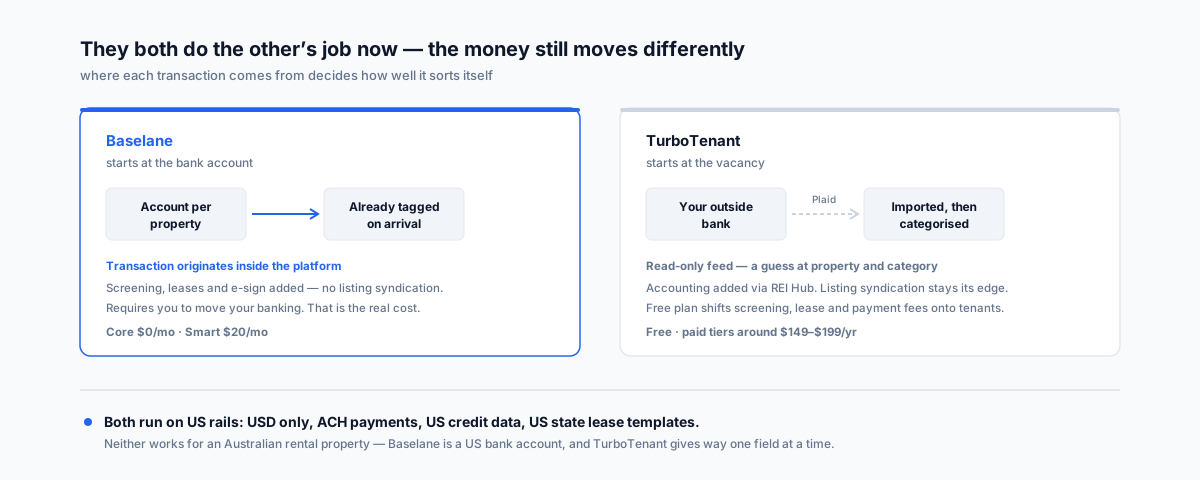
Baselane started at the bank account. It's a financial platform for property investors: business banking with unlimited property-specific accounts, automated bookkeeping, rent collection, and tax-package generation. Banking services are provided by Thread Bank, member FDIC — Baselane itself is a fintech, not a bank.
TurboTenant started at the vacancy. It's a landlord operations platform: listing creation and syndication, applications, screening, leases, rent collection, maintenance requests — the tenant lifecycle from advertisement to move-out.
Each has since built toward the other. But the centre of gravity hasn't moved, and it still predicts which one will feel like it's helping you.
The Real Difference: Where The Money Actually Lives
This is the distinction worth understanding, and it survives every feature update on both sides.
TurboTenant's accounting reads your bank. The accounting module is powered by REI Hub and connects to your accounts through Plaid, as a read-only feed. Transactions are imported, then categorised.
Baselane's accounting is your bank. Because the account is issued through Baselane's banking partner, the transaction doesn't need importing — it originates inside the platform, already attached to a property because you paid for it from that property's account.
That sounds like a technicality. In practice it decides three things:
- Categorisation accuracy. Imported transactions arrive as a merchant name and an amount, and something has to guess the property and category. Money moving through a per-property account already knows.
- Timing. A read-only feed is as current as the bank connection. Broken Plaid connections are the single most common complaint about every tool built this way.
- Failure mode. If you keep one bank account for six properties, importing gives you six properties of transactions in one undifferentiated stream. Baselane's answer is to stop doing that — open an account per property, free, and let the structure do the sorting.
The counter-argument is real, though: Baselane's approach only works if you're willing to move your banking. That's a bigger commitment than connecting a feed, and it's the reason plenty of landlords who prefer Baselane's model still don't switch.
Where TurboTenant Still Wins Outright
Filling a vacancy. This is the gap that hasn't closed. TurboTenant creates the listing, syndicates it to the major rental sites, and funnels enquiries into a single inbox with applications attached. Baselane's tenant management covers screening and leases; marketing the property is not what it does.
If your recurring pain is empty weeks between tenancies, that's TurboTenant's entire origin story and it's still the stronger product for it.
Being usable at zero cost. TurboTenant's free plan is genuinely functional for a landlord with a couple of properties, provided you accept where the costs land instead — see below.
Where Baselane Still Wins Outright
Banking structure. Unlimited checking and savings accounts, no minimums or maintenance fees, per-property and per-entity separation, physical and virtual debit cards with spend controls, and interest on balances. If you hold several properties across entities, this is the part TurboTenant has no equivalent to.
Security deposits. Many US states require deposits held separately, and having accounts you can open per property for free makes that administratively trivial rather than a chore.
Tax-package output. Both generate landlord tax reporting. Baselane's is built around producing a complete package per entity and property, which matters more the more entities you have.
What Each Actually Costs — And Who Pays
Headline pricing on both is cheap or free. The differences show up in who absorbs the fees.
Baselane — Core at $0/month, Smart at $20/month with a 30-day trial. The free tier includes the banking, rent collection and bookkeeping. Smart adds faster (2-day) rent deposits, AI auto-tagging, rule-based categorisation, receipt matching, balance sheet reports and priority support. ACH rent collection is free; card payments carry a processing fee borne by the tenant.
TurboTenant — Free, with paid tiers reported around $149/year and $199/year (figures vary by source and portfolio size, so treat them as indicative and check at signup). The free plan works by shifting costs to applicants and tenants: applicants pay roughly $55 to be screened rather than $45 on a paid plan, tenants pay a small convenience fee per ACH rent payment that paid plans waive, and state-specific lease agreements are charged per lease.
That last point deserves attention, and not only as a cost calculation. A screening fee difference of $10 is paid by every applicant for a property, not by you — so a free plan can be cheaper for the landlord and more expensive for the eight people who applied and didn't get it. Whether that matters to you is a judgement call, but it should be a conscious one rather than an accident of the plan you picked.
The Australian Problem
Here's the part the comparison articles never mention, and for readers of this site it outranks everything above.
Neither of these is usable for an Australian rental property. Not "works but awkwardly" — structurally not usable.
Baselane is the clearer case. The product is a US bank account. Deposits are held at a US bank, FDIC-insured, and opening one requires US identification and entity details. There is no version of Baselane that works from an account with a BSB.
TurboTenant is the more deceptive case, because you can create an account and start entering properties. Then the rails give way one at a time:
- Currency. TurboTenant's accounting displays USD only, with no ability to switch.
- Addresses. Properties are structured US-style, with state and ZIP as required fields.
- Bank connections. Transaction import runs through Plaid and Yodlee, which primarily support US institutions with some Canadian coverage. TurboTenant's own help documentation states the accounting product is built for US investors and doesn't guarantee functionality or appropriate reporting elsewhere.
- Screening. Applicant screening draws on US credit, eviction and criminal data. There is no Australian equivalent behind it, and an Australian applicant has no file to pull.
- Leases. The "state-compliant" lease templates mean US states. They have no relationship to a residential tenancy agreement under Victorian, NSW or Queensland law, and using one would be worse than using nothing.
- Payments. Rent collection runs on ACH. Australian rent automation runs on direct debit, direct credit, PayID and PayTo — a distinction we've written up separately, because the US-centric "direct deposit" language causes constant confusion here.
There's also a tax mismatch underneath all of it. Both products generate output shaped around US landlord tax reporting. Australian rental income is declared on your individual return, with a different deduction structure and capital works and depreciation rules that don't map across — the ATO's guidance on rental income you must declare sets out what's actually required. A tidy Schedule E package is not a step toward an Australian return.
And if you're an agency rather than an owner, the constraint that ends the conversation before any of this is statutory trust accounting, which neither platform does and which is set by your state's legislation rather than being a feature preference. We covered why that dominates the accounting-integration question in more detail.
What Australians Should Look At Instead
If you landed here because these two kept appearing in your search results, the honest redirect is that you were shown American products by an American-weighted index.
- Self-managing owners with a few properties — the local DIY tools are the right tier. Our guide to property management software for landlords in Australia covers what's actually available here, including Xero sync and state compliance.
- Anyone comparing the bigger platforms — the property management software landscape sorts the majors by portfolio size, and DoorLoop vs Rent Manager works through a comparison with the same American caveat attached.
- The banking-structure idea is still worth stealing. You can't have Baselane, but you can open a separate account per property with an Australian bank and get most of the categorisation benefit for nothing. That single habit does more for your end-of-year position than any software on either list.
How To Choose (If You're In The US)
- Your problem is vacancy — TurboTenant. Marketing and syndication remain the genuine gap between them.
- Your problem is that your books are a mess across several properties or entities — Baselane, and take the per-property accounts seriously; that's the whole mechanism.
- You want one tool and you're mostly full — Baselane covers more of the money side than the comparison articles credit it with.
- You want one tool and you're constantly re-letting — TurboTenant, with the accounting module switched on.
- You're unwilling to move your banking — that rules out most of Baselane's advantage. Be honest about this before signing up rather than after.
- You have one property and hate spreadsheets slightly less than software — neither is a bad answer, and both have a free tier, so the cost of being wrong is a couple of evenings.
Getting Help
The pattern worth avoiding isn't choosing the wrong one of these two. It's adopting a US-built platform because the reviews were glowing, entering six months of data, and then discovering the tax output doesn't map to what your accountant needs — which is a migration, not a settings change.
That risk is highest exactly where these tools look most convincing: the money side, where a US product's assumptions are invisible until year end. Our Small Business IT Support service works through what your portfolio actually needs against what each platform is built for, including whether it can legally and practically operate where your properties are.