
26 July 2026
"IT Support for Victorian Small Businesses: What \"Local\" Actually Needs to Mean"
Typing "IT support Victoria" into Google usually means wanting someone who understands the problem fast, not someone in the same postcode. What genuinely needs a technician on-site, what's fine remote, and the one free federal cyber security service worth knowing about.
Typing "IT support Victoria" or "IT support Melbourne" into Google usually isn't really a request for someone in the same postcode — it's a request for someone who'll actually pick up, understand the problem, and fix it without a week of back-and-forth. Physical proximity used to be a reasonable proxy for that, back when most IT problems meant someone standing in front of a server rack. Most don't, any more. The honest answer to "do I need a local provider" is that it depends entirely on what's actually broken, and conflating the two — assuming local means better, or assuming remote means worse — leads a lot of Victorian small businesses to rule out providers that would genuinely serve them faster.
What Actually Needs Someone On-Site
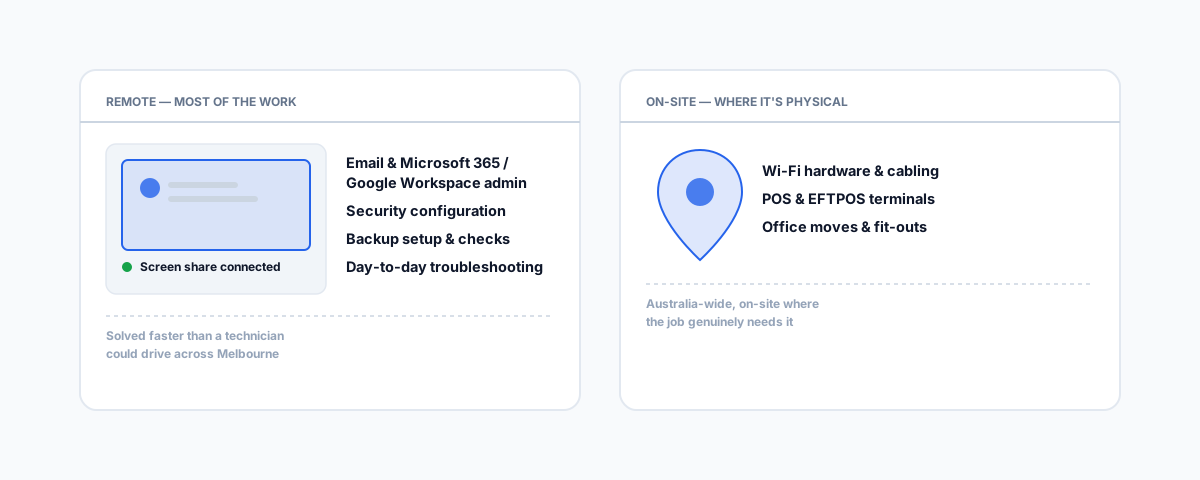
Some problems are physical and stay physical no matter how good the provider is. Wi-Fi dead zones and dodgy cabling in an office fit-out need someone walking the floor with a signal meter, not a remote session. POS terminals and EFTPOS hardware that won't pair, printers that won't network, and a new office move where phones, internet, and Wi-Fi all need to go live on the same morning are all genuinely on-site work. If a chunk of what your business needs falls into this category — a hospitality venue standing up a new POS and booking system is a common example, covered in our guide to IT support for hospitality venues — then proximity does matter, at least for that slice of the work, even if the rest doesn't need it.
What's Genuinely Fine Remote
Everything else mostly isn't physical any more. Email and Microsoft 365 or Google Workspace administration, security configuration, backup setup and verification, software troubleshooting, and the majority of "why isn't this working" calls a small business makes in a given month are all solvable over a screen share just as fast as in person — often faster, because a remote-first provider isn't burning half an hour in traffic before they even look at the problem. Our rundown of the IT problems that quietly cost small businesses time — lockouts, slow devices, failed backups, messy onboarding — covers the specific issues this applies to; almost none of that list needs a technician standing in your office.
Where Regional Victoria Connectivity Actually Matters
Remote support has one real dependency: your internet connection has to be working well enough to run a screen share and talk at the same time. In inner Melbourne that's rarely in question. Further out — regional Victoria, parts of the outer suburbs, older commercial buildings with patchy mobile coverage — it's a genuine variable, and it's worth asking a prospective provider directly what happens when the fault is the connection itself, not the thing you called about. A good remote-first provider has a fallback (phone-guided fixes, a mobile hotspot workaround, or scheduling an on-site visit when remote genuinely won't work) rather than being stuck the moment the screen share drops.
Free Help Worth Knowing About
Search results for Victorian government small business tech grants turn up a lot of programs that read as current but closed years ago — worth checking the actual close date before you plan around one. What is genuinely running right now is the federal Small Business Cyber Resilience Service, delivered by IDCARE: free, one-on-one cyber security support and incident recovery guidance for businesses with 19 or fewer full-time-equivalent staff, available Australia-wide including Victoria. It's advisory rather than a grant payment, but for a business that's had a scare or just wants a second opinion on where it stands, it costs nothing to use.
How to Actually Decide
Ask a prospective provider two things: what their actual response time commitment is (not "we'll get to it," a real number), and how they handle the physical work when it genuinely comes up — do they send someone themselves, or is that where the relationship quietly stops. A remote-first provider with honest, fast response times and a real plan for the on-site exceptions will solve more of your actual problems, faster, than a local provider whose only real advantage is the postcode on their website.
Getting Help
Our Small Business IT Support service is Australia-wide, remote-first, and on-site where the job genuinely needs it — covering Victorian businesses the same way it covers the rest of the country, without pretending proximity is the thing that actually fixes your Wi-Fi, your backups, or your inbox.