
10 July 2026
The Property Management Software Landscape: How the Major Platforms Compare (2026)
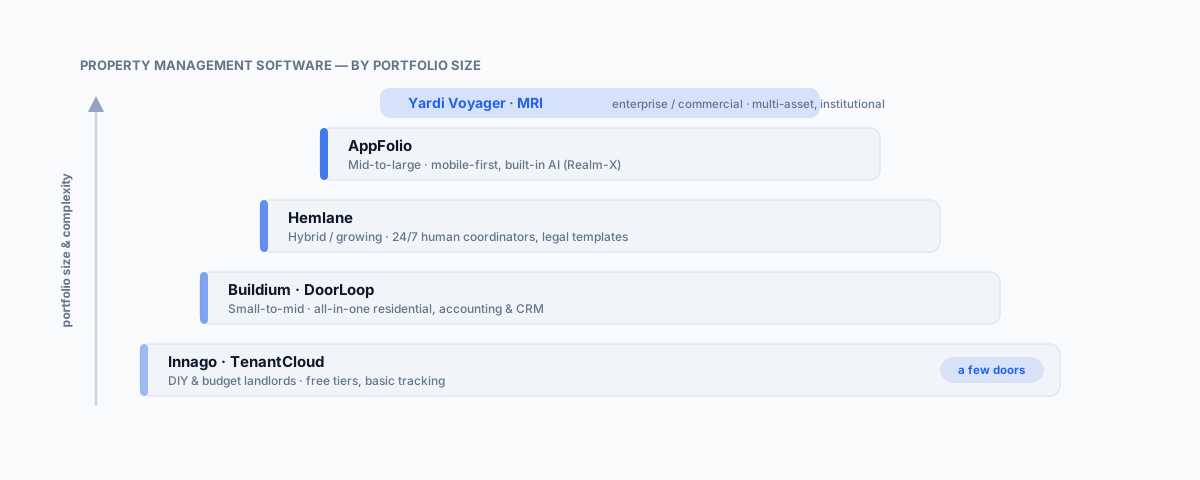
A market-landscape comparison of the major property management platforms — AppFolio, Buildium, Hemlane, DoorLoop, Innago/TenantCloud, and Yardi/MRI — by who they are best for, their key differentiator, and focus area, with guidance on choosing by portfolio size.
The property management software market is not one market — it is a ladder. At the bottom are free and cheap tools for landlords with a handful of doors; at the top are institutional platforms built for enterprises managing thousands of units across asset classes. Most confusion when choosing comes from comparing rungs that were never meant to be compared. The clearer way to read the landscape is by portfolio size and what each platform is genuinely built around. Here is how the major players line up.
The Platforms at a Glance
| Software | Best for | Key differentiator | Focus area |
|---|---|---|---|
| AppFolio | Mid-to-large portfolios | Built-in AI assistant (Realm-X) | Fast-growing, mobile-first operations |
| Buildium | Small-to-mid portfolios | Excellent built-in accounting & UI | All-in-one residential management |
| Hemlane | Hybrid / growing portfolios | 24/7 human repair & lease coordinators | Localized state/county legal templates |
| DoorLoop | Small-to-mid portfolios | Built-in CRM & incredibly fast onboarding | Modern, rapid setup UX |
| Innago / TenantCloud | DIY & budget landlords | Robust free-tier options for basic tracking | Cost-conscious independent landlords |
| Yardi Voyager / MRI | Large enterprise / commercial | Granular multi-asset & institutional accounting | Deep compliance, customization & forecasting |
Reading the Landscape
Grouped by where they sit on the ladder, the picture gets simpler:
- DIY and budget (Innago / TenantCloud). For independent landlords with a few properties, these lead with genuinely usable free tiers for rent tracking, applications, and basic accounting. The trade-off is depth — they are built to be cheap and simple, not to scale.
- Small-to-mid, all-in-one (Buildium and DoorLoop). The sweet spot for growing residential managers. Buildium is known for strong built-in accounting and a polished interface; DoorLoop leans on a built-in CRM and famously fast onboarding and setup. Both aim to be the single system a small-to-mid operation runs on.
- Hybrid and growing (Hemlane). Hemlane is distinctive for blending software with real people — 24/7 human repair and leasing coordinators — plus localized state and county legal templates, which suits landlords who are scaling but not ready for a full in-house team.
- Mid-to-large (AppFolio). For portfolios that are growing fast and operate mobile-first, AppFolio pairs breadth with a built-in AI assistant (Realm-X) to speed up day-to-day operations at scale.
- Enterprise and commercial (Yardi Voyager / MRI). At the top, these are institutional platforms — granular multi-asset and commercial accounting, deep compliance, heavy customization, and forecasting. Powerful and complex, and priced and scoped for organizations with the team to run them.
How to Choose
The honest way to pick is to match the rung to your reality, not your ambition:
- A few doors, cost-sensitive — start with a free or low-cost tier (Innago / TenantCloud) and upgrade only when the admin outgrows it.
- A growing residential portfolio — Buildium or DoorLoop, choosing on whether accounting depth (Buildium) or CRM and fast setup (DoorLoop) matters more to you.
- Scaling without a full team — Hemlane, for the human coordinators and legal templates that fill the gap.
- Large, fast-growing, mobile-first — AppFolio.
- Enterprise or commercial, multi-asset — Yardi or MRI, and budget for the implementation that comes with them.
The biggest mistake is buying up the ladder — an enterprise platform for a twenty-unit portfolio buries you in complexity you will never use, while outgrowing a DIY tool mid-scale forces a painful migration. Buy for the rung you are on, with a clear view of the next one.
For Australian Landlords
One important caveat: these platforms are predominantly US-focused, and their tax, trust-accounting, and legal-template features are built around US rules. If you are managing property in Australia, the local market has its own leaders — PropertyMe, Console Cloud, PropertyTree, and others built around Australian GST, state tenancy law, and bond handling. We cover those, split into DIY and rent-roll tiers, in our guide to the best property management software for landlords in Australia. For the wider real estate software picture, our SaaS stack for real estate agents covers the sales side.
The Bottom Line
There is no single best property management platform — only the right one for your portfolio size, your market, and how much complexity you can justify. Read the landscape as a ladder, place yourself honestly on it, and the shortlist chooses itself. And wherever you land, the tool that connects cleanly to the accounting and systems you already run will always beat the one with the longest feature list.