
20 October 2026
Variation and Progress Claim Approvals on Site: Why Construction Projects Need a Workflow, Not an Email Chain
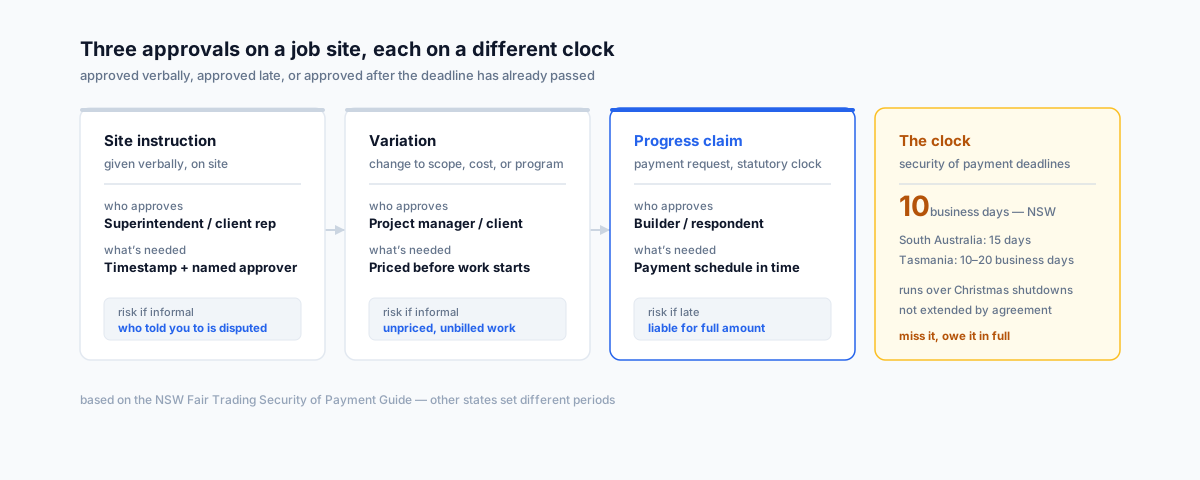
A variation sits unapproved in an inbox while the concrete gets poured anyway, and now nobody agrees who authorised it. Why site instructions, variations, and progress claims each need a formal approval point, what the Security of Payment Act actually does to a missed deadline, and what a workable approval workflow for a building project needs to have.
A site supervisor asks for a variation on a Tuesday — extra reinforcement, a changed footing detail, something the plans didn't anticipate. The email sits in a project manager's inbox while the crew keeps working, because stopping a pour to wait for a signature costs more than the variation itself. By Thursday the work is done, poured, and inspected. Nobody has actually approved anything. Three months later, at final accounts, the builder and the client disagree about whether that variation was ever authorised — and the only evidence either side has is an email that was never answered.
This isn't a paperwork problem. It's an approval problem, and construction has three distinct approval points that most small and mid-size builders run on verbal agreement, a text message, or a form that gets signed well after the work is already done.
Where The Approval Chain Actually Breaks
Three things get "approved" on every job, and they're not the same event:
- Site instructions — a direction to do something not explicitly shown in the contract documents, usually verbal, usually from a superintendent or client rep standing on site.
- Variations — a change to scope, cost, or program that should be priced and agreed before the work happens, but routinely gets approved retrospectively because stopping the job is expensive.
- Progress claims — the periodic request for payment against work completed, which triggers a statutory clock the moment it's served.
Each one has a different approver, a different timeframe, and a different consequence for getting it wrong. Treating all three as "stuff that gets signed off eventually" is exactly how a builder ends up doing unpriced work, or how a client ends up paying for a variation they never actually agreed to.
The Security Of Payment Clock Doesn't Wait For Your Inbox
This is the part that makes construction approvals different from almost any other approval workflow: one of them runs on a legislated deadline that doesn't care whether anyone saw the email.
Under security of payment legislation, once a progress claim is validly served, the respondent has a fixed window to issue a payment schedule disputing it — in New South Wales, generally 10 business days, per the NSW Fair Trading Security of Payment Guide. Miss it, and you don't get a shorter negotiation — you become liable for the full claimed amount, with no right to dispute it later. Other states run different clocks: South Australia's standard period is 15 days, and Tasmania runs 10 or 20 business days depending on whether the respondent is a building practitioner. The exact number matters less than the shape of the rule: it is absolute, it is not extended by agreement, and it keeps running over Christmas shutdowns and annual leave, which is exactly when most of these claims get missed.
A business that routes approvals through whoever happens to open their email that week is gambling against a deadline that doesn't negotiate. That's the liability case for formalising this, independent of how messy the paperwork feels day to day.
Three Approval Points That Need To Be Formal, Not Verbal
- Site instructions need a timestamp and a named approver the moment they're given — even a photo of a signed site diary entry beats a verbal "yeah, do it," because the dispute three months later is never about whether the work happened, it's about who told you to.
- Variations need a price and a sign-off before the work starts wherever that's physically possible, and a documented reason when it isn't — "approved after the fact because stopping the pour would have cost more" is a defensible position; "nobody remembers agreeing to this" is not.
- Progress claims need an internal approval step that finishes with enough buffer to issue a payment schedule inside the statutory window — not a process that starts the clock running before anyone with authority has looked at it.
What A Real Construction Approval Workflow Needs
Most of what's sold as "approval workflow software" is built for office paperwork — a form, a reviewer, a tick. A construction approval workflow has to survive a site, which means it needs:
- Dollar-threshold routing — a $400 variation and a $40,000 variation shouldn't take the same path to the same approver; routing by value is how you keep small changes fast without letting large ones slip through on the same light-touch process.
- Mobile capture from site — if approving something requires being at a desk, it will get approved after the fact, every time; the record has to be creatable from a phone, on site, at the moment the instruction is given.
- A timestamped audit trail— not a signature at the end, but a record of who requested it, who approved it, and when, because that sequence is the entire substance of a later dispute.
- A direct link into job costing— an approved variation that doesn't flow into the job's cost tracking is a variation the business will under-bill, which is a slower and quieter way to lose the same money.
Build It Into What You Already Run, Or Bolt One On
If the business already runs job-management software built for trades — tools in the vein of Buildxact, Fergus, or Simpro — the approval step for variations and progress claims is very likely already in there, unused, because it was switched on by default and nobody set the thresholds. That's worth checking before buying anything new. If the business is running job costing in a general ledger with no construction-specific layer on top, a generic approval tool can still do the job for the progress-claim and variation sign-off step specifically — our broader rundown of approval workflow software options for Australian businesses covers the document- and money-approval categories that apply here, without the construction-specific framing.
Either way, the fix is rarely a new tool. It's deciding, in writing, who approves what, by when, and making sure that decision is captured at the moment the work happens — not reconstructed from a text thread after the final account is in dispute.
Getting Help
If approvals on a job are living in texts, verbal instructions, and emails nobody answers, the gap usually isn't a missing app — it's a process that was never set up to route the right thing to the right person in time. Our workflow automation team can help map site instructions, variations, and progress claims onto a workflow that fits how the job actually runs, and connects to the accounting and job-costing system already in place.