
30 July 2026
Landlord Software for Student Housing: Why Room-by-Room Leases Need Different Tools
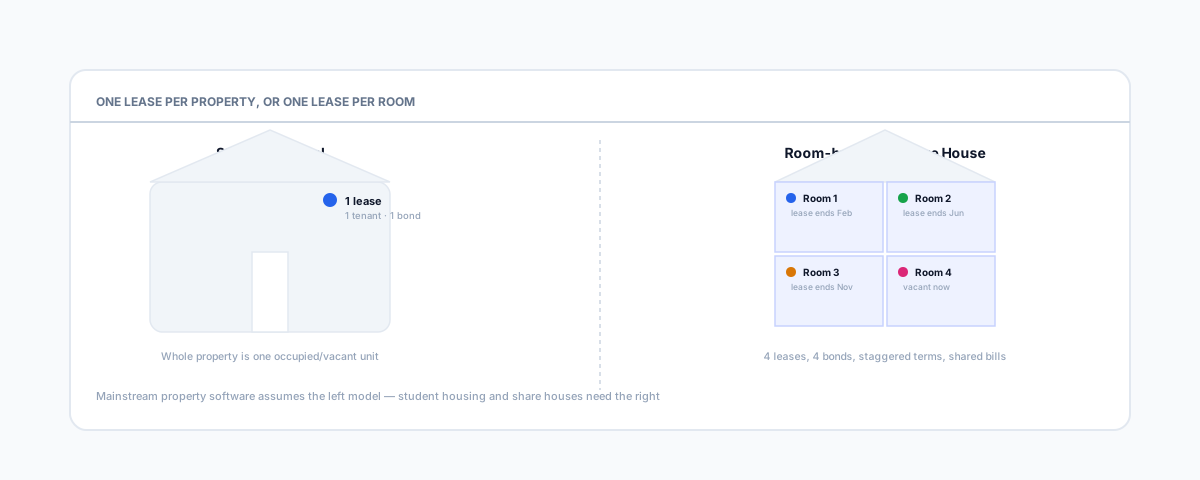
Standard property management software assumes one lease per property. Student housing and share houses break that assumption — each room has its own tenant, lease, and bond. What structurally differs, the boarding house compliance wrinkle, and what to look for instead.
Search for landlord software as someone renting out a student share house or a house full of individually-let rooms, and most results assume something that isn't true for you: one lease, one household, one tenant relationship per property. That assumption is baked into almost every mainstream property management tool, because it matches how most rentals actually work. Student housing and room-by-room share houses don't work that way — a single property might have four tenants, four separate leases, four different move-in dates, and four bonds, while the electricity bill, the lawn, and the empty room in March are all shared or property-level problems. Software built around "one lease per property" doesn't bend easily to that shape, and the gap shows up as manual workarounds: a spreadsheet bolted onto whichever app handles the leases it can, tracking the parts it can't.
What's Actually Different About Room-by-Room
Before comparing software, it's worth being precise about what actually differs from a standard rental, because it changes what the tool needs to track:
- Per-room leases and bonds — each occupant has their own agreement and their own bond, not a joint lease covering the whole property. Losing one tenant doesn't end the tenancy for the others.
- Staggered terms — leases start and end on different dates throughout the year, following the academic calendar rather than a single annual renewal.
- Shared costs, individual tenants — utilities, internet, and common-area cleaning are billed at the property level but need splitting across tenants who may not have moved in or out on the same day.
- Mixed liability — some arrangements are genuinely separate (each tenant liable only for their own room and rent), others are joint and several (all tenants liable for the whole property) — the software needs to reflect which one actually applies, not assume either.
- Room-level vacancy, not property-level — a four-room house with one empty room is not "vacant" or "occupied," it's 75% occupied, and that's a different reporting and marketing problem than a single-tenancy property sitting empty.
A tool that only understands "property" and "tenant" as a 1:1 relationship has to fake all of this with workarounds — separate line items, manual notes, a side spreadsheet for the bill split — which is usually where the admin burden actually comes from, not from the number of tenants itself.
The Compliance Wrinkle: Boarding Houses Aren't Standard Tenancies
In several Australian states, a property let room-by-room with shared facilities can fall under boarding house or lodging house law rather than the standard residential tenancy act — and the rules genuinely differ, not just in name. In NSW, for example, the Boarding Houses Act 2012 caps a security deposit at two weeks' occupancy fee, and — unlike a standard tenancy bond, which must be lodged with NSW Fair Trading's Rental Bond Board — a boarding house deposit is not required by law to be lodged with the regulator at all. That's a materially different obligation to build a process around, not a footnote: software (or a manual process) that assumes every bond gets lodged the same way will get this wrong for a boarding-house-style tenancy. Other states have their own equivalents with their own thresholds, so the practical takeaway isn't "NSW's rules apply to you" — it's to check whether your state treats room-by-room letting as a boarding house, lodging house, or share-housing arrangement before assuming standard tenancy bond and notice rules apply, and to make sure whatever system you use reflects the answer rather than a generic default.
What to Look For in the Software Itself
Once the structural and compliance differences are clear, the feature list to actually check becomes specific:
- A per-room, per-tenant ledger — rent, bond, and payment history tracked at the room and tenant level, not lumped into a single property record.
- Individual lease templates with staggered terms — the ability to generate and manage leases that start and end on different dates within the same property, without treating each one as a separate "property" in the system.
- Bond handling matched to the correct regime — configurable for whichever bond rules actually apply (standard tenancy vs boarding house/lodging house), rather than one hard-coded bond process.
- Shared-cost splitting — utilities and common-area costs divided across current tenants automatically, prorated for whoever was actually there for the billing period.
- Room-level occupancy and turnover reporting — vacancy, upcoming lease-end dates, and re-letting status shown per room, so a property with a mix of full and empty rooms shows correctly instead of as a single occupied/vacant flag.
Mainstream Landlord Tools vs Purpose-Built Student Housing Platforms
Our broader guides to property management software for Australian landlords and the wider platform landscape cover tools like PropertyMe, Cubbi, Landlord Studio, Buildium, and AppFolio — all genuinely strong options, and all built around the property-as-the-unit model. For a landlord with one share house of individually-let rooms, some of these can still work with enough manual workaround, particularly if bond and lease rules in your state don't differ much from a standard tenancy. But at real scale — purpose-built student accommodation (PBSA) with dozens or hundreds of rooms across one or more buildings — the workaround stops being viable, and this is where specialist platforms take over. StarRez is the clearest example: it's built around configurable bed- and room-level management as the core unit rather than an add-on, handling non-standard lease structures, room selection, and renewals natively. It's used at scale in Australia — Campus Living Villages, which manages tens of thousands of student beds across Australia, New Zealand, the UK, and the US, runs on it. That's the practical dividing line: a handful of rooms in one property is a "make the mainstream tool work" problem, while a portfolio of purpose-built student accommodation is a "you need software actually built around rooms" problem.
Which Camp Are You In
The honest questions to answer before choosing are the same ones that separate self-managing landlords from rent-roll agencies in our other guides, just applied to rooms instead of properties: how many individually-let rooms are you actually managing, does your state treat this as a standard tenancy or a boarding house/lodging arrangement, and is the admin burden from bond and bill-splitting workarounds, or from genuine scale? A share house with three room-let tenants and a landlord doing it themselves rarely justifies PBSA-grade software — a mainstream tool plus a disciplined process for the bond and bill-split differences will usually do the job. A multi-building student accommodation operation almost always needs the room-native platform, because the workaround cost compounds with every additional room.
Getting Help
Figuring out which side of that line you're on — and getting the bond, lease, and bill-splitting process right for your state — is the part worth getting right before you commit to software either way. If you'd like help auditing your current setup or getting a new system configured properly, our Small Business IT Support service can take that off your plate.