
21 July 2026
E-Invoicing via Peppol in Australia: What's Actually Mandatory (Government Only) and Whether Your Business Should Adopt It Anyway
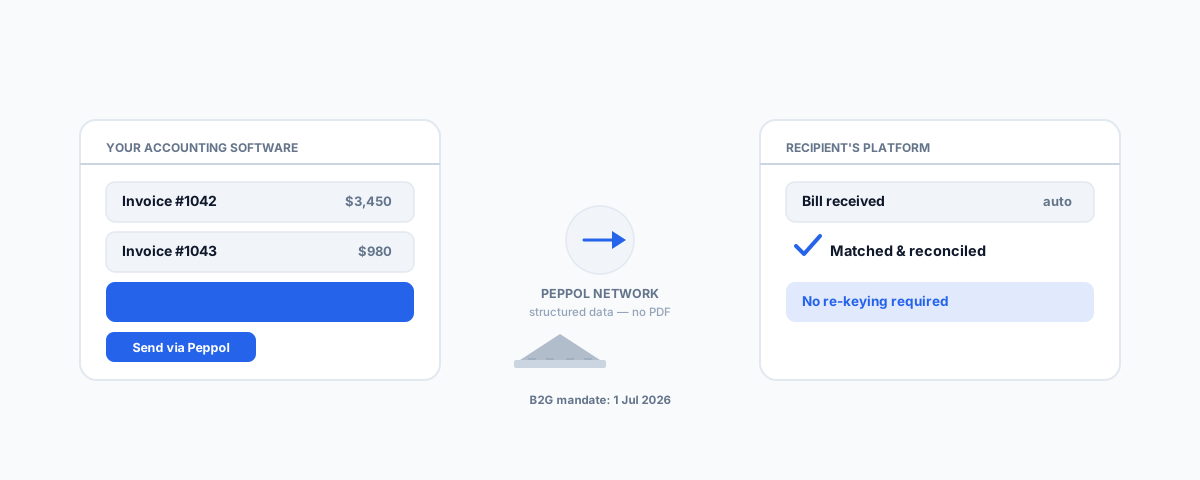
Federal agencies must receive 30% of invoices via Peppol by July 2026 and fully automate by December — but there is no mandate for private business. What the government deadline actually means for suppliers, and how to set up e-invoicing in Xero, QuickBooks, or MYOB if it's worth doing anyway.
Search "e-invoicing mandatory Australia" and you will find no shortage of headlines implying every business now has to comply with something on a deadline. It is worth being precise about what is actually happening, because the real news is narrower than the headlines suggest, and the honest answer changes what you should do about it. There is a real, dated mandate — but it applies to federal government agencies receiving invoices, not to the businesses sending them. Here is what is actually locked in, why it still matters if you invoice the Commonwealth, and the case for adopting Peppol e-invoicing anyway even though nothing forces you to.
What Is Actually Mandatory, and Who It Binds
The mandate applies to Non-Corporate Commonwealth Entities — federal government agencies — not to private businesses. By 1 July 2026, these agencies must receive at least 30% of their invoices via the Peppol e-invoicing network. By December 2026, they must be able to both send and receive e-invoices with fully automated processing, and report their progress quarterly to the Australian Peppol Authority. The ATO, which administers Australia's Peppol policy as the country's Peppol Authority, is explicit that there is no direct legal mandate for private-sector suppliers. If your business does not invoice a federal agency, nothing about this deadline legally requires you to change anything.
Why It Still Reaches Suppliers
The mandate is on the receiving agency, but the practical effect lands on whoever is sending them invoices. An agency chasing a 30% Peppol-received target has an obvious lever to pull: ask its suppliers to send that way. If you invoice a Commonwealth department or agency — as a contractor, a services provider, or a supplier of goods — expect that request to arrive as a procurement condition or a polite nudge from your contact, not as a law. This has already happened once before: since 2022, NCEs have been required to be able to receive Peppol invoices, and agencies that receive them commit to paying eligible invoices within 5 days — a real cash-flow incentive for a supplier to switch, mandate or not.
What Peppol E-Invoicing Actually Is
Peppol is not email with a PDF attached, and it is not a portal you log into. It is a structured-data network: your accounting software sends an invoice as machine-readable data directly into your customer's accounting software, validated against a standard format, with no PDF, no email inbox, and no manual re-keying on either end. That structure is also the security benefit worth knowing about — a Peppol invoice cannot be intercepted and edited by a business email compromise scam the way a PDF invoice sitting in an email thread can, because it never travels as an editable document in the first place.
The Case for Adopting It Without Being Told To
Three reasons make this worth doing on your own timeline rather than waiting for a customer to ask.
- Most platforms already support it — Xero, QuickBooks Online, and MYOB all have Peppol send/receive built in or available via an add-on, so the technical lift is usually a setting, not a project.
- Faster payment is real — if any of your customers are government agencies or larger businesses already on Peppol, some pay e-invoices faster specifically because reconciliation is automatic on their end.
- Fraud reduction applies either way — removing the PDF-in-an-email step closes off one of the more common invoice fraud vectors small businesses actually experience, regardless of who you invoice.
The ATO has also run co-funded small business support for adoption, on the reasonable bet that voluntary uptake now is cheaper than a scramble later if a mandate ever does extend to B2B — which several other countries have already done, even though Australia has not.
Setting It Up
The practical steps are the same regardless of which platform you're on. You register with an ATO-accredited Peppol Service Provider — this is usually your accounting software vendor acting as, or partnering with, one, not a separate signup. In Xero, e-invoicing is a setting under your organisation's e-invoicing preferences, connected to the Peppol network directly. QuickBooks Online supports e-invoicing through its own Peppol connection, enabled from the invoicing settings. MYOB offers it through partner integrations rather than a fully native toggle, so check your specific plan. Once connected, your Peppol ID — typically built from your ABN — becomes discoverable on the network, and any customer already on Peppol can find and invoice you, or receive invoices from you, without either of you doing anything manual. If your accounting data already lives in one of these platforms, our guide to automated cloud backup for accounting software is worth pairing with this — a Peppol connection is one more integration with write access to your books, which is exactly the kind of access that makes a tested backup non-optional.
If Your Invoicing Runs Through a Field-Service Platform
Not every business invoices straight out of Xero or QuickBooks. Trades and field-service businesses often invoice through a platform like Jobber, with the accounting sync happening behind the scenes — a different shape of automation, covered in our guide to automating Jobber with Zapier and its API. If that's your setup, Peppol readiness depends on whichever accounting platform sits behind it, not the field-service tool itself.
Getting Help
Whether you're weighing this because a government customer has asked, or you're deciding if the switch is worth making early, the setup itself is a small, well-defined job — a Peppol connection, a check of your invoicing workflow, and confirmation that your existing accounting data is properly backed up before you add another integration to it. Our Small Business IT Support service handles exactly this kind of platform setup end to end. There is no deadline forcing your hand yet — which is precisely why now, calmly, is the better time to do it than in a rush once one arrives.