
28 July 2026
T-Mobile's July 2026 Outage: The Same Single-Carrier Risk, a Third Time This Year
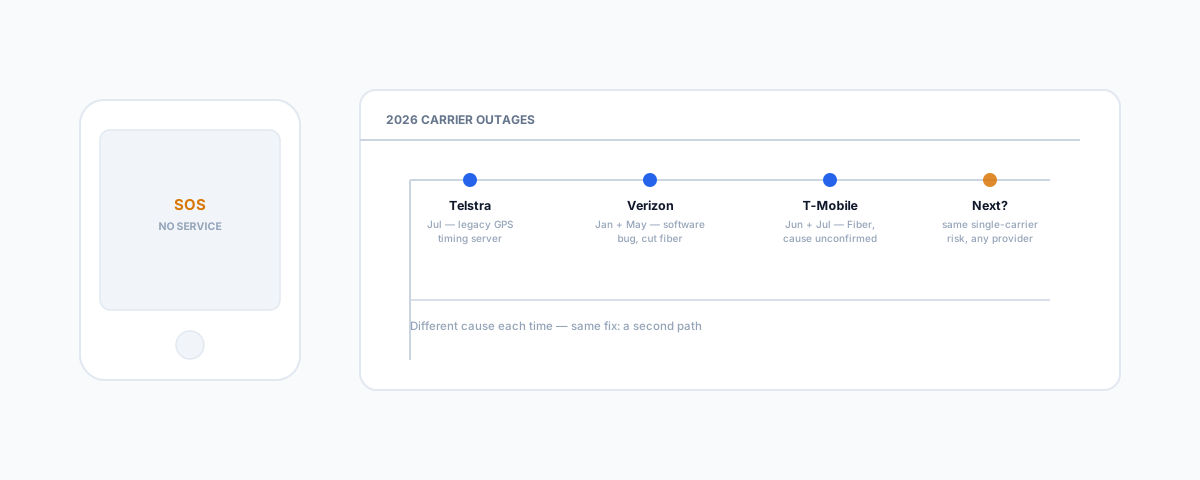
T-Mobile went down for over 60,000 US users on July 27, 2026 — its second outage in two months after a multi-day Fiber outage in June. It is the third major carrier outage this year with a different cause and the same lesson — single-carrier dependency is the risk, not any one company's network.
On the evening of July 27, 2026, T-Mobile went down for tens of thousands of users across the United States — texts failing, calls dropping, phones losing signal from the East Coast to Los Angeles. Reports on Downdetector passed 62,000 within the first hour, according to wire coverage of the incident, and as of publication T-Mobile has confirmed it is investigating but has not confirmed a cause. That's worth being upfront about: unlike the Telstra and Verizon outages covered here in the past few weeks, this one is still unfolding and the "why" isn't nailed down yet. What's already clear without the specific cause is the pattern this fits into — and the pattern is the actually useful part.
A Third Carrier, a Third Unrelated Cause
This masthead has now covered a carrier going down three times in about a month, for three completely unrelated reasons. Telstra's July outage traced back to a fifteen-year-old GPS timing server that misread a satellite clock rollover. Verizon's two 2026 outages were a software bug shipped in a routine update and, separately, a physically cut fiber cable. Now T-Mobile — and worth noting, this is T-Mobile's second outage in two months, after a Fiber outage in June that dragged into a fifth day for some customers in the southeast US. Three carriers, three countries' worth of customers, three different technical triggers, none of them an attack. That is not a coincidence worth explaining away — it's what happens when a business's connectivity runs through exactly one company's infrastructure, because eventually that company has an ordinary bad day.
Why the Cause Doesn't Actually Change the Lesson
It's tempting to wait for T-Mobile's post-incident report before drawing a conclusion, but the specific mechanism has not mattered to any business that lost trading time in the last two outages either — a GPS rollover bug and a severed cable produced the identical result: no calls, no card payments, no way to reach customers. Whatever T-Mobile eventually confirms, it will almost certainly be similarly mundane, because outages caused by anything more dramatic than routine software and hardware failure are the rare exception, not the norm. The businesses that keep asking "which carrier is safest" are asking the wrong question — the honest answer, three outages in, is that reliability varies year to year and incident to incident, and none of them are immune.
A Quick Self-Check Instead of Repeating the Playbook
Both the Telstra and Verizon posts already cover the specific redundancy options in depth — dual-SIM and eSIM failover, dual-modem setups, SD-WAN failover, and backup payment paths — so rather than repeat that list, here's a faster way to find out if it applies to you. Walk through each of these and be honest about the answer:
- Payments — if your primary connection died right now, could you still take a card payment within the next five minutes, on a different network path?
- Phones — does your business phone system depend on one mobile carrier only, or does it also run over the internet (so a carrier-specific outage doesn't take it down)?
- Internet — if you're a bricks-and-mortar location, is your connectivity a single line from a single provider, or is there a second path that doesn't share the same physical infrastructure?
- Customers — if calls and SMS both failed at once, is there another channel — email, WhatsApp, a booking system — customers already know to use?
If you answered "no second path" to more than one of those, that's the actual finding — not which carrier is next.
Getting Help
Three outages in a month is enough evidence that this isn't a one-carrier problem to route around by switching providers — it's a single-point-of-failure problem that exists regardless of which logo is on the bill. Our Small Business IT Support service audits exactly these single points of failure — payments, phones, and connectivity — and builds in the second path before the next outage makes the decision for you.