
23 July 2026
The July 2026 Telstra Outage: What It Actually Was, and What Small Businesses Should Do About Payment and Comms Redundancy
A 15-year-old GPS timing server nobody replaced took down calls, EFTPOS, and data across Australia for the better part of a day. What actually caused the July 2026 Telstra outage, the real cost to small businesses running Tyro and CommBank terminals, and the redundancy that would have kept trading through it.
Just before 4:30am on Wednesday 8 July 2026, Telstra's mobile network started failing across the country. By the time most businesses opened their doors, calls were dropping, EFTPOS terminals couldn't connect, and regional trains had stopped running. Telstra's own network was largely back within the day, but the ripple effects — stalled payments, missed calls, businesses working out how much the outage actually cost them — ran well beyond that. The cause, once it came out, was almost anticlimactic: not an attack, not a cyber incident, but a piece of hardware installed around 2011 that Telstra's own supplier had already warned it about.
What Actually Happened, and When
Calls and data began failing around 4:30am AEST. By 10am, Telstra had restored roughly 90% of services, and the network was reported fully recovered by 4pm — but the flow-on effects for businesses trying to process payments and claim compensation ran into a second day. Telstra was explicit and consistent throughout: this was not a cyberattack. Several mobile virtual network operators that run on Telstra's infrastructure — Boost Mobile, Belong, Aldi Mobile, and Tangerine — went down alongside it, which is worth knowing if you assumed switching to a budget SIM reseller gave you a different network underneath.
The Actual Cause — a Legacy Hardware Problem, Not a Mystery
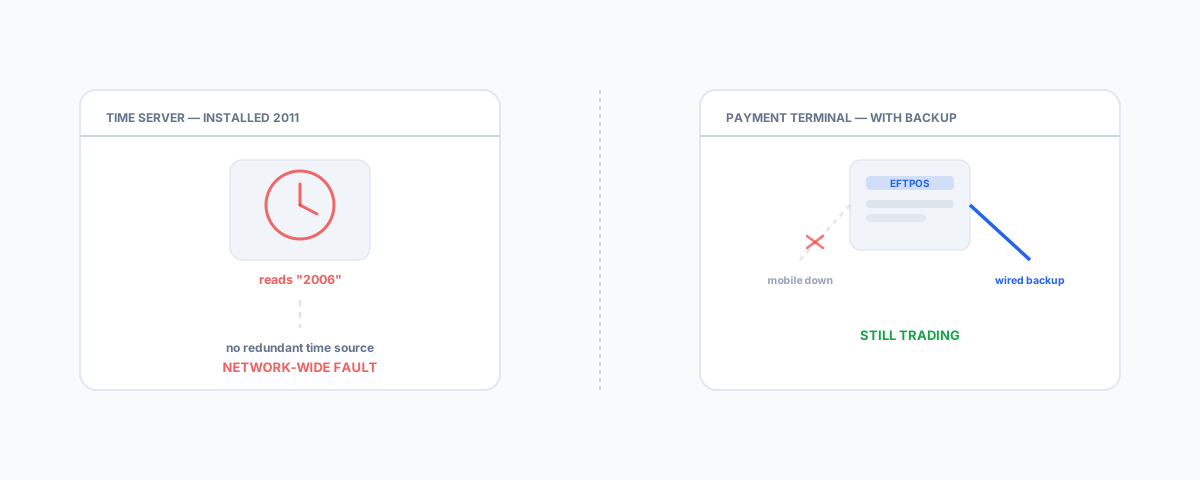
The root cause is genuinely worth understanding rather than glossing over, because the lesson only lands if you know what actually broke. Telstra's network depends on precise time synchronisation across its infrastructure, provided by a dedicated time server — in this case, a unit installed around 2011. GPS satellites broadcast time as a count of weeks since a fixed reference date, and that counter rolls over every 1,024 weeks, or roughly 19.6 years. After a routine restart, the aging server misread that rollover and effectively decided it was 2006, not 2026. Because Telstra didn't have sufficient redundant, independently-verified time sources to catch the error, the network couldn't reach consensus on the correct time — and time consensus is foundational to how a mobile network actually functions, so the fault cascaded into calls and data failing nationwide. The manufacturer had reportedly flagged this exact vulnerability as far back as 2022, and again in January 2026. This wasn't an exotic failure mode; it was a known, dated risk on ageing infrastructure that didn't get replaced in time.
What It Actually Cost Small Businesses
This is where the outage stopped being a telecom story and became a small business story. Tyro, whose EFTPOS terminals serve roughly 80,000 Australian businesses, confirmed that some merchants couldn't connect their terminals over the mobile network during the outage. CommBank confirmed some of its merchant customers were affected too, with services restored by around 9:40am. For a cafe, salon, or retailer that takes most of its trade over card, several hours without EFTPOS on a normal trading morning is a real, countable dollar figure — not a minor inconvenience. In response, Small Business Minister Anne Aly publicly urged affected businesses to keep records of their financial losses, and Telstra opened a dedicated compensation hotline for businesses to lodge claims.
The Regulatory Fallout
The scale of the disruption — including 333 welfare checks Telstra conducted on customers whose Triple Zero calls failed or dropped, six of whom needed immediate follow-up — triggered a formal response. The Australian Communications and Media Authority is investigating whether Telstra met its statutory network reliability obligations, with potential civil penalties running up to $30 million per breach, and has separately asked government for stronger investigative powers over telcos. Whatever the outcome, it doesn't change what a business could have done differently on the day — which is the part actually within your control.
Building Redundancy That Would Have Kept You Trading
None of this means every small business needs enterprise-grade telecom infrastructure. It means having a second path that doesn't share the same failure point as your main one:
- A second payment path — a POS with genuine offline mode that queues transactions until connectivity returns, or a backup terminal on a different network or provider, means a mobile network outage doesn't stop you taking payments outright. Our guide to the card surcharge ban and POS pricing checklist covers the payment-settings side of running a resilient checkout.
- Comms that don't rely solely on mobile — a cloud-based business phone system such as GoTo Connect runs over the internet rather than a single mobile carrier, so a carrier-specific outage doesn't take your phone lines down with it.
- A wired connection alongside mobile broadband — for venues and offices, having both an NBN or fibre connection and a mobile failover (rather than mobile as the only option) means one network's bad day doesn't become yours. Our guides to IT support for hospitality venues and Wi-Fi and networking for a small office or venue both cover this failover in more depth.
- A messaging channel that survives a carrier outage — if SMS is part of how customers reach you, our guide to integrating WhatsApp and SMS into a business phone system covers running messaging over more than one channel.
The Honest Takeaway
Nothing about this outage was exotic or unique to Telstra — it was old hardware, a known and dated vulnerability, and a network that didn't have enough redundancy built in to catch its own mistake. That's exactly the situation many small businesses are in with their own single points of failure, just at a smaller scale: one payment terminal, one phone line, one network connection, with no second path if it goes down on an ordinary Wednesday morning.
Getting Help
Working out where your business has a genuine single point of failure — payments, phones, or your network connection — and building in a second path that actually holds up during an outage is a straightforward project once it's scoped properly. Our Small Business IT Support service designs and sets up exactly this kind of network and payment failover, so the next carrier outage is an inconvenience rather than a lost trading day.