
3 July 2026
What to Look For in Shopify Website Development Services
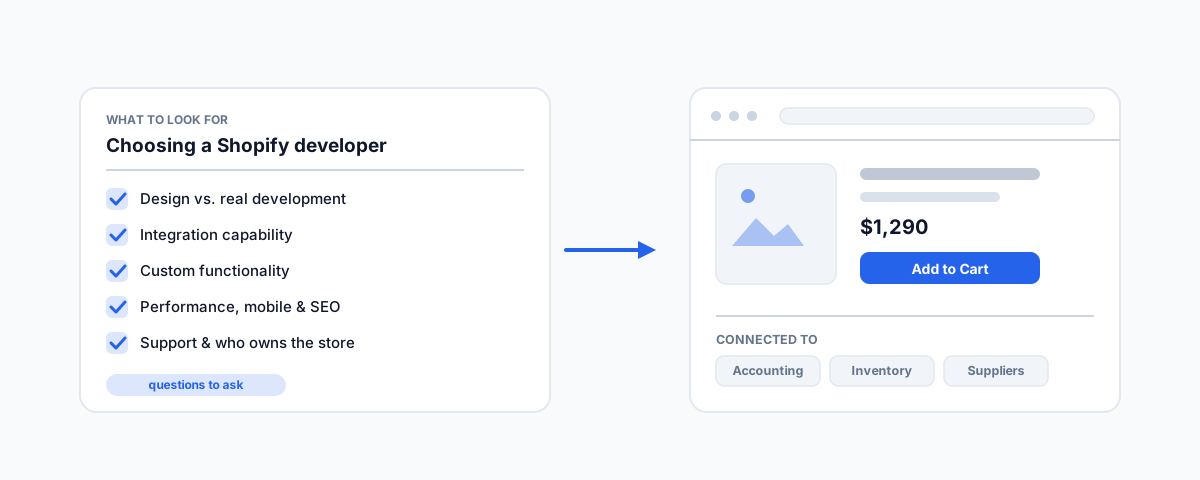
A buyer's guide to choosing Shopify website development services — the difference between a theme-tweaker and a real developer, the integration and custom-build capability that actually matters, and the questions that separate a store that just launches from one that runs your business.
"Shopify website development" covers an enormous range. At one end it is a $200 theme swap and a logo; at the other it is a custom build wired into your accounting, inventory, and suppliers that quietly runs a chunk of your business. Both get advertised with the same words, so the first job when you go shopping is working out which one you actually need — and then telling whether the person quoting you can deliver it. Here is what separates a store that just launches from one that keeps working, and what to look for before you hand over money.
Know What You Actually Need First
Before you compare providers, get honest about the job. Do you need a good-looking storefront set up on a solid theme, or do you need the store to do things — sync stock, price products from a supplier feed, push orders into your accounting, book installations, handle subscriptions? The first is largely design and configuration work; the second is genuine development. Plenty of frustration comes from paying design money for a development problem, or the reverse. A good provider will ask about this on the first call. If someone quotes a flat price before understanding what the store has to do behind the scenes, that is a signal, not a bargain.
Design Versus Development
Most "Shopify developers" are really theme customisers — and for a straightforward store that is often exactly right and far cheaper. They start from a premium theme, adjust colours, fonts, and layout, set up collections and pages, and get you live. The skill there is taste and configuration, not code. Real development starts where the theme stops: editing Liquid templates, building sections and blocks that do not exist off the shelf, and writing custom logic. When you talk to a provider, get clear on which they do. Ask to see work that goes beyond a re-skinned theme. The difference matters enormously for anything non-standard, and it is the single most common mismatch between what a business bought and what it needed.
Integration Is Where the Real Value Is
For most businesses, the storefront is the easy part — the value is in what the store connects to. Can they wire Shopify into your accounting so orders and payouts reconcile without manual entry? Can they keep one stock pool accurate across Shopify and your other sales channels so you are not overselling? Can they pull prices from a supplier feed with your markup, or push orders into a POS or CRM? This is the work that removes daily admin and prevents costly mistakes, and it is where a capable developer earns their fee many times over. It is also where the pretenders fall away — connecting systems reliably is harder than styling a page. We have written about several of these in detail, from keeping stock accurate with multichannel inventory sync to selling products that need installation and automating product data cleanup at scale. If a provider cannot talk fluently about integrations, they are a storefront builder, not a store builder — know which one you are hiring.
Custom Functionality Beyond the App Store
Shopify's app store solves a lot, and a good provider reaches for a proven app before writing code — that is usually the cheaper, more maintainable choice. But apps have limits: they conflict, they slow the store down, they charge monthly forever, and sometimes none of them does quite what you need. The mark of a genuine developer is knowing when to use an app and when to build — with Shopify's line item properties, the Admin API, custom sections, or a small app of their own. Ask how they would approach a requirement that no app covers cleanly. The answer tells you whether they can only assemble other people's pieces or actually build the missing one, and that is the capability you are paying a premium for.
Performance, Mobile, and SEO
A store can look perfect and still lose sales quietly. Most Shopify traffic is on phones, so a mobile-first build is not optional. Page speed directly affects both conversion and search ranking, and it is easy to wreck with heavy apps, oversized images, and bloated themes — so ask how a provider keeps the store fast. On SEO, the basics need to be right from the start: clean URLs, proper page titles and metadata, structured data, and a sensible collection structure. These are cheap to get right during the build and expensive to retrofit later. A provider who never mentions speed, mobile, or search is thinking about how the store looks the day it launches, not how it performs the month after.
Support, Documentation, and Who Owns the Store
The build is a moment; the store is a long relationship. Find out what happens after launch. Is there support when something breaks during a sale? Who holds the admin access and the accounts — you, or them? Will you get documentation of what was built and how the integrations work, or is it a black box only they can touch? The worst position to be in is locked to one contractor because nobody else can understand the store, and the person who built it has gone quiet. Insist that you own the Shopify account, the domain, and any custom code, and that the setup is documented well enough for someone else to pick up. That single condition protects you more than almost anything else in the engagement.
Questions to Ask Before You Hire
A few direct questions separate the capable from the confident:
- Can you show me work beyond a customised theme — something you actually built?
- How would you connect this store to our accounting, inventory, or supplier systems?
- If no app does what we need, would you build it, and how?
- How do you keep the store fast on mobile?
- What do you hand over — accounts, code, and documentation — and who owns it?
- What does support look like after launch, and what does it cost?
You are not testing for perfect answers; you are testing whether they engage with the substance or deflect to price and timelines. The good ones welcome these questions because the answers are where they shine.
A Note on Local Support
If you are running a business in Australia, there is real value in a provider who understands the local context — GST-aware accounting integrations, Australian payment and shipping setups, and support in your timezone when a problem hits during your trading hours rather than overnight. It is not essential for every store, but for anything that touches money, tax, or fulfilment, working with someone who has done it here before saves a lot of translation.
Getting Help
Good Shopify website development is less about a pretty storefront — that part is increasingly commoditised — and more about whether the store does the work your business needs, connects reliably to the systems you already run, and stays maintainable long after launch. If you would like a store built and integrated properly, with the accounting, inventory, supplier, and custom pieces working as one and documented so you are never locked in, our Shopify Integrations service designs and builds exactly that. Get the foundation right, and the store stops being a thing you maintain and becomes a thing that works for you.