
12 July 2026
White Label Real Estate Marketing Software for Brokerages: A Buyer's Guide (2026)
What white label real estate marketing software is, why a brokerage would rebrand a platform as its own, what to look for on branding depth, portal and CRM integration, pricing and data ownership, and the pitfalls to avoid before you commit.
Every agent in your brokerage needs marketing tools — listing collateral, social posts, email, single-property websites — and you have three ways to provide them. You can let every agent bring their own, and watch your brand fragment into fifty slightly different versions. You can build a platform from scratch, which is expensive and slow. Or you can white label an existing platform: license a vendor's marketing software and present it to your agents as your own, under your name, your logo, and your domain. For most brokerages the third path is the pragmatic one — but only if you understand what you are actually buying and where the sharp edges are. This is a buyer's guide to getting it right.
What "White Label" Actually Means Here
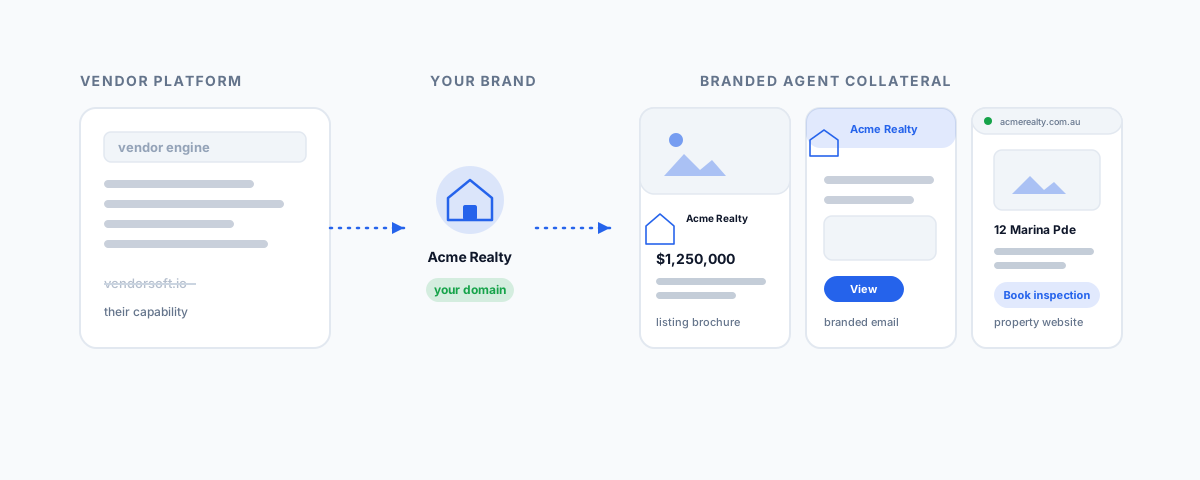
White label means the software is built and run by a vendor, but wears your brand instead of theirs. Your agents log in to a portal with your name and logo on it, generate collateral that carries your branding, and send emails from your domain — and at no point does the underlying vendor's name appear. In a good implementation, an agent could work in the platform every day and never know whose software it really is. That is the whole idea: the capability is the vendor's, but the brand equity is yours.
It is worth being precise about how this differs from the brand-governance software we cover in our guide to enterprise real estate marketing software. That is about keeping agents on-brand inside your marketing — locked templates, approval workflows. White label is a step before that: it is about whose brand the software itself carries. The two go together — you white label a platform, then use its governance features to keep agents consistent within it — but they are answering different questions.
Why a Brokerage Would Want It
The case for white label comes down to a few real advantages:
- Brand equity compounds to you. Every listing ad, email, and single-property site your agents produce reinforces your brokerage's brand rather than advertising a software vendor. Over thousands of touchpoints a year, that is a meaningful asset you are building instead of renting.
- Recruitment and retention. Offering agents a polished, branded marketing suite as part of joining your brokerage is a genuine drawcard — and one they cannot simply take with them, because it is tied to your brand and systems.
- You look established. A branded platform makes a small or mid-size brokerage present like a national network, without the budget of one.
- Speed over building. You get a full marketing suite in weeks by rebranding a mature product, instead of spending a year and a large budget building your own and maintaining it forever.
What Gets White Labelled
The scope of what carries your brand matters, and it is worth mapping before you buy. In a full white-label real estate marketing setup, your branding typically covers the agent-facing marketing suite end to end: listing brochures and social ads, single-property websites, branded email and newsletters, CMAs and listing proposals, and the agent portal or app itself — all served from a custom domain that is yours, not a vendor subdomain. The deeper the branding goes, the more it genuinely feels like your own product rather than a skin over someone else's.
What to Look For
Not all white-label offerings are equal, and the differences are easy to miss in a demo. Weigh these:
| What to check | Why it matters |
|---|---|
| Depth of branding | Custom domain, your logo and colours, and — critically — no vendor name leaking into URLs, email headers, footers, or support. Shallow branding undercuts the whole point. |
| Portal and CRM integration | It must pull listings and contacts from your CRM (AgentBox, Rex, Box+Dice) and push campaigns to realestate.com.au and Domain, or agents re-key everything. |
| Pricing model | Usually per agent or per seat. Model the cost at your current and target headcount — per-seat pricing that is fine at 20 agents can hurt at 200. |
| Data ownership and export | Your listing, contact, and campaign data must be yours, exportable in a usable form if you leave. Confirm this in writing before you commit. |
| Agent ease-of-use | If the on-brand path is slower than an agent's own tools, they route around it and you are back to brand drift. Adoption is the whole game. |
| Support and reliability | You are now dependent on the vendor's uptime and support, but your agents will come to you. Check SLAs and how support is escalated under your brand. |
Get depth of branding and integration right in particular — a platform that nails features but leaks the vendor's name in every listing URL, or that cannot talk to your CRM and the portals, will undermine both the brand benefit and the time savings you bought it for.
The Pitfalls to Plan For
White label is the pragmatic path, but it is not free of trade-offs, and the ones that bite are predictable:
- Leaky branding. The vendor's name has a way of surfacing in link previews, email authentication headers, PDF metadata, or the moment an agent contacts support. Audit the whole journey, not just the login screen.
- Vendor lock-in. Your agents' workflows, templates, and data now live in someone else's system. The harder it is to export and the more your operations depend on it, the more leverage the vendor has at renewal.
- Cost scaling. Per-seat economics that make sense today can become the most expensive line item in your marketing budget as you grow. Know the curve before you sign.
- Roadmap dependence. You are at the mercy of the vendor's priorities. Features you need may never come, and features you rely on can change.
- Compliance stays yours. Rebranding the software does not transfer responsibility — Australian underquoting and advertising rules, and REA and Domain portal specifications, are still your brokerage's obligation to meet.
White Label Versus Building Your Own
The honest framing is that white label sits between two extremes. Letting agents fend for themselves is cheap and chaotic; building your own platform gives you total control, no per-seat ceiling, and no vendor lock-in, but costs real money upfront and an ongoing commitment to maintain it. White label is the middle path: fast and affordable to start, at the price of depending on someone else's product and pricing.
For many brokerages the smartest approach is a hybrid — white label a platform to move quickly now, while integrating it cleanly with your CRM and, over time, custom-building the specific pieces that matter most to your brand so you are not wholly dependent on one vendor. If you are still assembling the underlying stack, our guides to SaaS for real estate agents and the best email marketing platform for real estate agents cover the adjacent tools that a white-label marketing layer sits on top of.
Getting Help
Rolling out a white-label marketing platform is less about the software and more about the wiring — connecting it to your CRM and the portals, auditing the branding so nothing leaks, setting up templates and agent onboarding, and deciding which pieces to rely on the vendor for versus build yourself. Get those right and it feels like your own product; get them wrong and it is an expensive skin your agents route around. If you would like it scoped, integrated against your actual CRM and portals, and set up so your agents genuinely adopt it, our Workflow Automation service handles the integration and rollout — so the platform carries your brand cleanly and does the work you bought it for.