
6 July 2026
WooCommerce vs Shopify for Large Stores: Cost, Multi-Language, and Whether to Switch
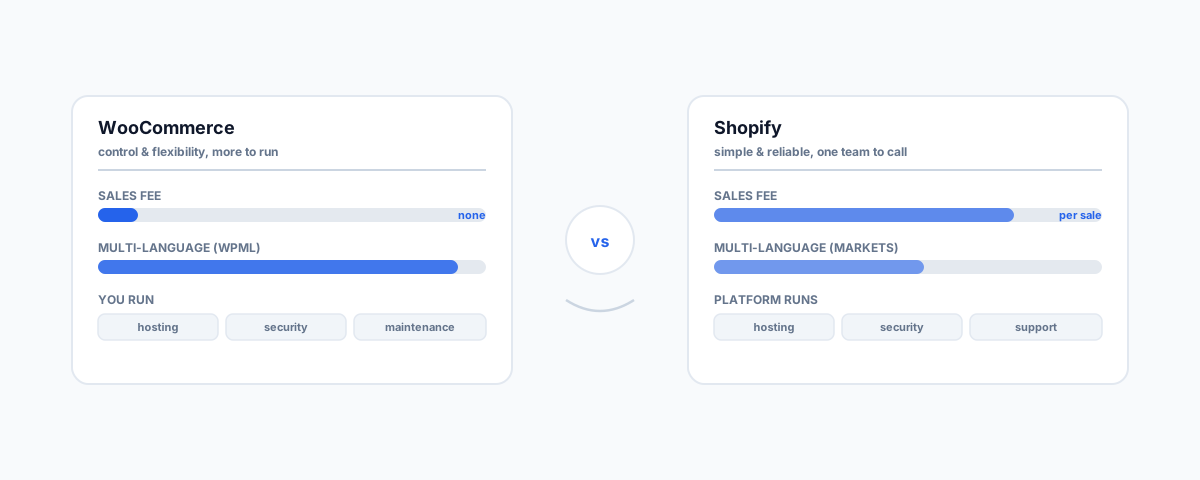
A straight comparison for stores weighing WooCommerce against Shopify — whether WooCommerce really works out cheaper at scale, how the two handle multi-language, and the honest pros and cons of switching from Shopify to WooCommerce.
When a store grows past a certain size, the platform question comes back around. Shopify got you here with its ease and reliability, but the fees add up, and WooCommerce starts to look tempting — cheaper on paper, more flexible, and yours to control. Before you move, three questions deserve honest answers: is WooCommerce actually cheaper at scale, how do the two compare on multi-language, and what are the real trade-offs of switching? Here is a straight comparison, and a verdict at the end.
Is WooCommerce Cheaper Than Shopify for Large Stores?
This is the question that drives most switches, and the honest answer is: it depends on what you count. Shopify charges a monthly plan fee, and — unless you use Shopify Payments — a transaction fee on every sale. At high volume, that per-sale cut is the number that stings, and it is the single biggest reason large stores look elsewhere. Add the monthly cost of the apps a big store relies on, and Shopify's total can climb steeply as you scale.
WooCommerce, by contrast, is a free plugin — but "free" is misleading, because you take on the costs Shopify was absorbing for you. You pay for hosting (and a large store needs serious hosting), development and maintenance, security, and premium extensions for the features that come built into Shopify. What WooCommerce does not charge is a platform fee on your sales. So the real picture is this: at large scale, WooCommerce can genuinely work out cheaper because you escape the per-sale fee, but only if your sales volume is high enough to outweigh the hosting, development, and maintenance you are now responsible for. It is not cheaper because it is free; it is potentially cheaper because the cost structure shifts from per-sale fees to fixed operational costs — which favours high-volume stores.
Shopify vs WooCommerce: Multi-Language Support
If you sell across languages, the two platforms take very different approaches. Shopify handles multi-language natively through Markets and its Translate & Adapt tool, which is clean and well-integrated but more constrained — there are limits on how many languages and how deeply you can customise each one, and some of it leans on apps. WooCommerce, through plugins like WPML or Polylang, offers deeper and more flexible multilingual (and multi-currency) capability — you can translate essentially everything and shape each language's experience — at the cost of more setup and more moving parts to maintain. The pattern is the one that runs through this whole comparison: Shopify is simpler but more boxed-in; WooCommerce is more powerful but more work. For serious multilingual stores, WooCommerce usually wins on capability; for a couple of languages done simply, Shopify is less hassle.
Switching from Shopify to WooCommerce: Pros and Cons
If you are seriously considering the move, weigh both sides honestly.
The pros:
- No platform transaction fees — you keep the per-sale cut Shopify was taking.
- Ownership and control — you own the store, the data, and the code, with no risk of platform rule changes.
- Flexibility — open-source means you can customise almost anything and choose from a vast plugin ecosystem.
- Content and SEO — WooCommerce runs on WordPress, still the strongest platform for content marketing and blogging.
The cons:
- You own the maintenance — hosting, security, updates, and backups become your responsibility, not the platform's.
- More setup and complexity — more moving parts to configure and keep working together.
- No single support line — when something breaks, there is no one Shopify-style support team to call; responsibility is spread across host, plugins, and developer.
- You need technical resource — running WooCommerce well assumes a developer or partner, where Shopify is designed to run without one.
The move itself is very doable when planned — we walk through the mechanics in moving from Shopify to WooCommerce, and the same care applies going the other way.
So Which Should You Choose?
The verdict is genuinely about your store, not a winner. If you are a high-volume store paying significant transaction fees, want deep multilingual or customisation, and have (or will hire) technical capability, WooCommerce can be cheaper and far more flexible — the switch pays off. If you value simplicity, reliability, and one team to call, do not have technical resource in-house, and the fees are not yet painful, Shopify's higher cost is buying you real convenience and is often worth it. The trap is switching to WooCommerce for the "free" and discovering you have simply traded platform fees for operational work you were not ready for.
Getting Help
Choosing between WooCommerce and Shopify — and executing the move if you go ahead — is a decision worth getting right, because the cost of switching for the wrong reasons is high. If you would like an objective assessment of which platform actually fits your store, or the migration and build handled properly whichever way you land, our Shopify Integrations team works across both platforms and can help you decide with the numbers in front of you. Make the call on evidence, not on which one looks cheaper at a glance.