
21 October 2026
MYOB Ecommerce Integrations: What Actually Connects to Business, AccountRight, and Advanced
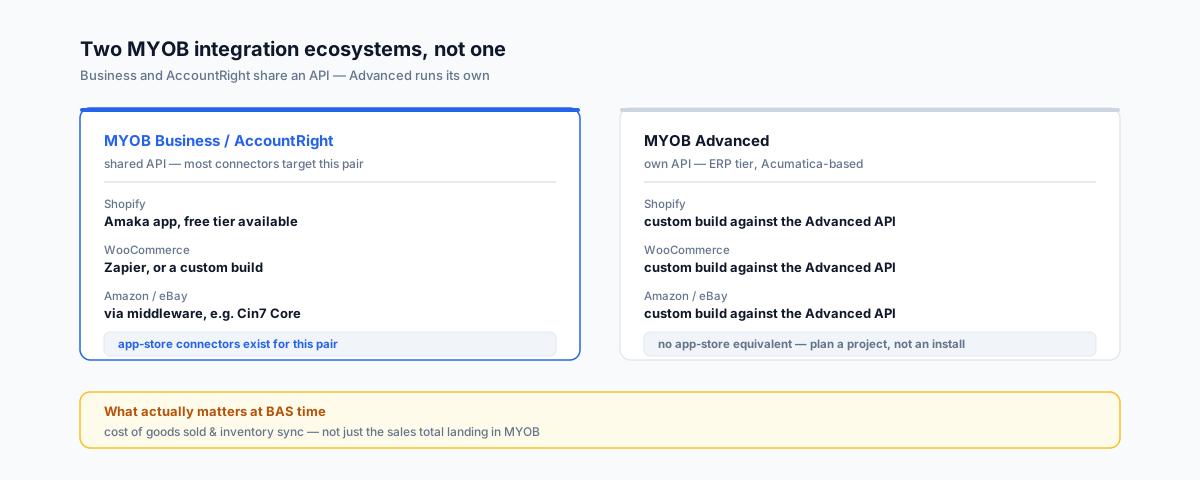
"MYOB" isn't one product — Business, AccountRight, and Advanced each sit on a different API, which is why a connector that works for one often doesn't exist for another. What actually connects Shopify, WooCommerce, and marketplaces to each MYOB tier, and where you're looking at a custom build instead.
"Does MYOB integrate with my store?" doesn't have one answer, because MYOB isn't one product. MYOB Business and MYOB AccountRight share an API and a connector ecosystem built around small-to-mid businesses. MYOB Advanced is a different system entirely — an ERP tier with its own API — and a connector built for the first two generally doesn't exist for the third. Before asking which platform connects, it's worth confirming which MYOB you're actually on.
Three Products, Two Integration Ecosystems
MYOB Business (including the Lite and Pro tiers) and MYOB AccountRight both sit on the same developer platform, which is what the app marketplace and most third-party connectors are built against. If a connector says it supports "MYOB," this is almost always the pair it means.
MYOB Advanced runs on different infrastructure, inherited from its Acumatica-based ERP lineage, with its own developer API separate from the Business/AccountRight surface. It's aimed at larger, more complex operations, and the practical result is that the free or low-cost app-store connectors built for Business and AccountRight simply don't extend to it. If your store needs to talk to MYOB Advanced, start from that assumption rather than hunting for an equivalent of a tool built for the smaller tier.
Shopify — The Best-Covered Case
Shopify into MYOB Business or AccountRight is the most mature of the lot, through MYOB's own Amaka-powered integration — free for low order volumes, with paid tiers adding inventory and COGS sync as the store grows. We've covered the setup, pricing tiers, and when to move to a custom connector in detail in our Shopify MYOB integration guide; if payouts are already connected but the reconciliation itself doesn't balance, our piece on reconciling Shopify payouts in MYOB covers that specifically. Neither applies to MYOB Advanced — Shopify-to-Advanced is a custom build against Advanced's own API, not an app-store install.
WooCommerce — Thinner Options, No Default Answer
WooCommerce doesn't have an equivalent of Amaka's dominant, purpose-built MYOB connector. The realistic options are a Zapier-based sync for simple order and contact flows, or a custom integration against the MYOB Business/AccountRight API for anything involving inventory, COGS, or multi-currency. Budget for the custom path by default rather than assuming a free plugin will appear to match what Shopify has.
Amazon And eBay — A Middleware Layer, Not A Direct Link
Marketplaces don't talk to MYOB directly in either product tier. The usual pattern is a multichannel inventory and order management layer — something like Cin7 Core (formerly DEAR Systems), which already integrates with MYOB AccountRight — sitting between the marketplace and the accounting file, consolidating orders from Amazon, eBay, and any other sales channel before they land in MYOB as a single feed. This is worth planning for even if you only sell on one marketplace today: it's the same middleware layer you'd need if a second channel gets added later.
MYOB Advanced Projects Run On A Different Timeline
Because MYOB Advanced sits on its own API, an ecommerce connection to it is typically a partner-built project rather than an app-store toggle — closer to the custom-connector end of the Shopify comparison than the free tier. Confirm this early: a timeline and budget scoped around "install an app" doesn't match what Advanced actually requires, and finding that out after a go-live date has been promised is the expensive way to learn it.
Get The Inventory And COGS Mapping Right Before You Trust The Numbers
Whichever path connects your store, the sync that actually matters for BAS time is cost of goods sold and inventory — not just sales totals. The ATO's record-keeping requirements for business expect GST and sales records that reconcile to what actually happened, and a connector that only syncs a daily sales summary without COGS can leave your margin reporting wrong even while the bank feed balances perfectly. Check what each option actually syncs, not just whether it connects.
Getting Help
The right MYOB ecommerce integration depends on which MYOB you're running, which platform you're selling on, and whether a free connector covers what you actually need or you're looking at a custom build from the start. Our workflow automation team can confirm which path applies to your setup and scope the build if it turns out to be a custom one.