
5 August 2026
PagePilot AI: What It Generates, and What You Can Actually Publish in Australia
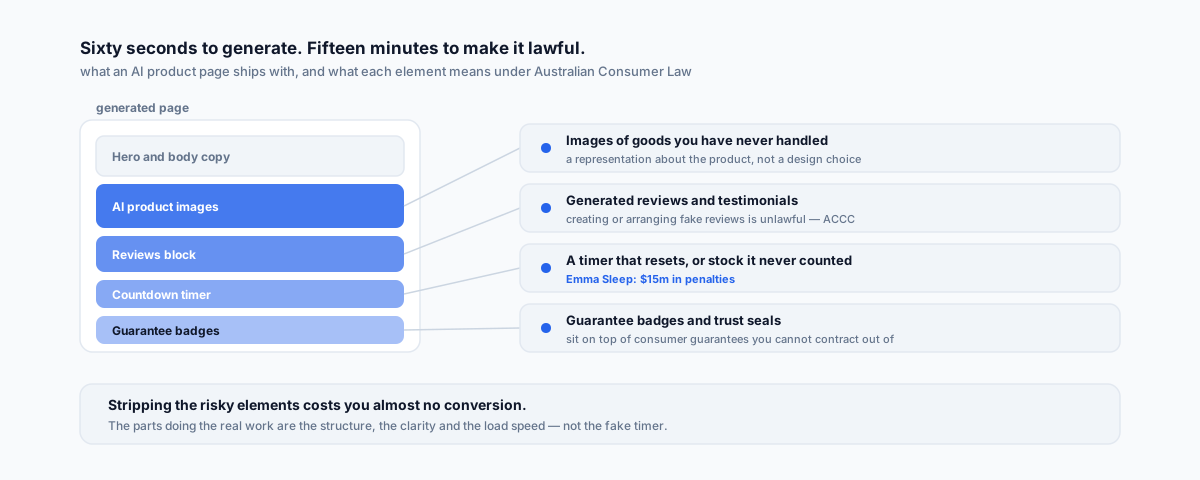
PagePilot turns a supplier URL into a finished product landing page in about a minute — copy, images, reviews, urgency timers, guarantee badges. The tool works. The question nobody reviewing it asks is which of those generated elements an Australian merchant can lawfully publish, and the ACCC has been fining people over exactly this.
PagePilot is a Shopify app that takes a supplier link — AliExpress, Amazon, another Shopify store — and returns a complete product landing page in about a minute. Headline, body copy, AI-generated product images, a features section, a reviews block, an FAQ, a guarantee badge, and matching ad creative for Facebook, TikTok and Google. It imports straight into your store.
It does that well. This isn't a piece arguing the tool is bad, because on the specific job it's built for it's fast and the output is competent. But every review of it currently on page one of Google is published by a company selling a competing page builder, and all of them stop at the same place: features, pricing, verdict. None of them asks the question that actually matters if you're trading in Australia — which of the things this tool generates for you can you lawfully publish?
That question has real money attached to it, and the answers are on the public record.
What PagePilot Actually Does
The core loop is genuinely one step. You give it a product URL, it scrapes the product, and it writes a landing page around it. What comes back:
- Structured page sections — hero, benefits, comparison, social proof, FAQ, guarantee — assembled from a library of templates and blocks rather than a blank canvas.
- AI-generated product imagery, including lifestyle-style shots the original supplier listing never had.
- Ad creative for Facebook, TikTok and Google, plus meta titles and descriptions.
- Translations into more than 30 languages.
- Direct import to Shopify, working with any theme, plus integrations with Judge.me, Klaviyo and a handful of upsell and COD apps.
It carries Shopify's Built for Shopify badge, which is a real signal about performance and integration quality — it is not a signal about anything on this page.
Who It's Genuinely For
This is where most of the disappointment in the review pile comes from, so it's worth stating plainly. PagePilot is a product-testing tool. The workflow it's designed around is: find a product, generate a page in a minute, put paid traffic at it, see whether anyone buys, kill it or scale it. At that job the economics make sense, because the cost of a page approaches zero and you can afford to be wrong most of the time.
It is not a store builder, it is not a supplier or fulfilment tool, and it will not give you a brand. The negative reviews it does have are largely from people who expected one of those three things. If you're an established retailer with your own products, photography and voice, this is not the tool you're looking for — what a complete Shopify store build actually includes is a more useful starting point.
What It Costs
There's a free plan, a 7-day trial, and paid tiers starting at $39/month for Lite, or around $390 on annual billing. Third-party reviews describe higher tiers in the region of $59 and $99, with the difference being volume rather than capability — the feature list is broadly the same across plans. Several reviewers also note that you can build on the free plan but need to be paying to publish into Shopify.
Treat all of those numbers as indicative and check the current listing, because app pricing moves.
The Review Distribution Is Worth a Look
PagePilot sits at about 4.8 out of 5 from roughly 150 Shopify reviews. Different trackers report slightly different figures — 4.8 from 150, 4.9 from 141, 4.8 from 146 — which is normal for a live count.
The part worth noticing is the shape rather than the average: roughly 95% five-star, 5% four-star, and nothing below four stars at all. At that review volume, no software has zero unhappy users. That distribution can have innocent explanations — a young app, a narrow and self-selecting user base, active support catching problems before they become reviews — and it isn't evidence of anything on its own. It's simply a reason to weight the average a little less heavily than the number suggests, and to read the four-star reviews first.
The Part No Review Mentions: What You're Actually Publishing
Here is the gap. A generated landing page arrives with several elements that are conversion furniture in the US dropshipping playbook and are regulated conduct in Australia. The ACCC has named manipulative online practices and misleading pricing claims among its enforcement priorities, and it has been backing that with penalties.
Generated review and testimonial sections. The ACCC is explicit that it is unlawful to create fake or misleading reviews, or arrange for others to create them. Reviews must reflect genuine customer experiences, undisclosed relationships make them misleading, and selectively suppressing negative reviews is itself a breach. A social-proof block populated with generated or imported testimonials for a product you have never sold is not a design choice — it's a representation about other customers' experiences that didn't happen. Service Seeking was ordered to pay $600,000 over publishing misleading reviews.
Countdown timers and low-stock warnings. This is the sharpest one. The ACCC's Black Friday sweep found retailers running timers that claimed a sale was about to end when it actually continued past the deadline. Enforcement followed: Emma Sleep was ordered to pay a total of $15 million in penalties, with the ACCC specifically concerned about a countdown timer that reset itself and claims that the sale was ending soon. Michael Hill, My House and Hairhouse Online also paid penalties over Black Friday claims. A timer that resets on refresh, or a "only 3 left" counter that isn't reading your actual inventory, is the exact conduct in those cases.
AI-generated images of goods you have never handled. A generated lifestyle image showing a product in a setting, at a scale, in a finish or in a colour that differs from what ships is a misleading representation about the goods. This is a bigger risk with AI imagery than with supplier photos, because the model will confidently render details — texture, size relative to a hand, what's in the box — that nobody has verified.
Guarantee and badge blocks. "30-day money-back guarantee", "lifetime warranty", trust seals. Publish one and you have made a promise you must honour. Worse, these sit on top of the consumer guarantees in the Australian Consumer Law, which apply automatically and cannot be contracted out of. A generated page that implies your returns policy is the customer's only remedy is misrepresenting rights they already have.
And the guarantees follow you, not your supplier. If you sell it, you are the supplier for ACL purposes. A 40-day shipping time from an overseas warehouse and a supplier who stops answering email does not transfer the repair, replacement or refund obligation away from you. That's the structural reason dropshipping compliance is harder here than the US playbook assumes.
Using It Without the Exposure
None of this means don't use the tool. It means treat its output as a first draft with known hazards, and check the same short list every time before you publish:
- Turn off, or make true, every urgency element. A timer is fine if the sale genuinely ends when it says and doesn't reset. A stock counter is fine if it reads real inventory. Neither is fine as decoration.
- Delete the generated social proof. Replace it with nothing until you have real reviews, then collect them through a review app that records genuine verified purchases. An empty section beats a fabricated one, legally and commercially.
- Check every generated image against the actual product. If you haven't held it, order one. This is also the cheapest possible protection against the chargeback wave that follows "not as described" — a pattern covered in fraud and chargeback prevention for Australian Shopify stores.
- Substantiate or delete every specific claim. Generated copy produces numbers — percentages, timeframes, "clinically proven", comparisons to competitors. If you can't evidence it, cut it. Comparative claims about named competitors are their own category of risk.
- Rewrite the guarantee block to match your real policy, and make sure nothing on the page suggests your policy replaces the customer's statutory rights.
- Check your pricing display. Strikethrough "was" prices need to reflect a price the product was genuinely sold at. This is the same trap covered in the card surcharge ban and POS pricing checklist, from a different direction.
That list takes about fifteen minutes per page. It removes most of what makes a generated page a liability, and — worth saying — it removes almost none of what makes it convert, because the parts doing the real work are the structure, the clarity and the load speed, not the fake timer.
The Honest Verdict
PagePilot is a good tool aimed at a specific job, priced reasonably for that job, and it does in a minute what used to take a day. The risk isn't in the software. It's that it generates, by default and in seconds, a set of page elements that Australian regulators have been actively fining businesses for publishing — and it has no way of knowing which jurisdiction you're trading in.
Speed of publishing has outrun speed of checking. That's the actual problem with AI page builders, and it isn't going to be solved by a better page builder.
Getting Help
If you're running a Shopify store in Australia and using AI tooling to produce pages at volume, the exposure isn't hypothetical and it compounds with every page you ship. Our Shopify Integrations work covers store setup and the plumbing around it — inventory, payments, reviews, accounting — with an eye on what you're actually publishing, rather than just whether it deploys. If nothing else, run the fifteen-minute checklist above across the pages you already have live.