
28 July 2026
Telstra Business Internet and Mobile: What Small Businesses Actually Need vs What Gets Upsold
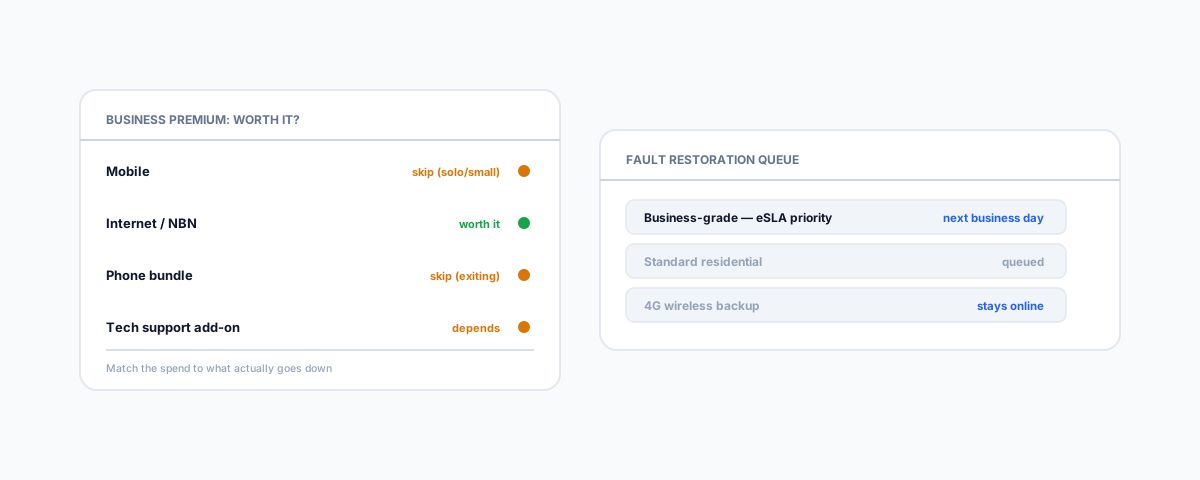
Telstra Business costs more than a consumer plan across mobile, NBN, and phone — but the premium only pays off for specific things. What Telstra Business actually adds over consumer-grade, what is genuinely worth paying for, and where a small business is better off going elsewhere entirely.
Telstra Business isn't one upgrade — it's three separate premiums, sold as a bundle: mobile, internet, and phone, each priced above the consumer equivalent, each justified by a different set of features. The problem is that those three premiums don't all pay off the same way. Some of what "Business" buys you is genuinely worth paying for if downtime costs you money. Some of it is close to identical to the consumer plan sitting right next to it on the same website. Here's what's actually different, tier by tier, and where the money is well spent.
Mobile: The Premium Buys You Less Than You'd Think
Telstra's own business and consumer SIM-only plans are close to identical in price, data, and network access — the same towers, the same speeds, the same inclusions like Telstra Air and the Telstra Plus rewards program. The genuine difference is administrative, not technical: business plans let you pool data across every service on the one account, so five staff on five SIMs share one data allowance instead of five separate caps, plus shared billing and easier user management as the team grows. If you're a sole trader or a two-person operation, that pooling benefit barely matters and a personal or Belong plan on the same network will do the same job for less. If you're managing a team of phones, the account-management side is the real reason to be on a business plan — not better coverage.
Internet: This Is Where the Premium Actually Buys Something
Business-grade NBN and fibre plans are a genuinely different product, not just a relabelled consumer plan. A dedicated, uncontended connection means your speed doesn't dip when the whole street gets home from school and starts streaming — you're not sharing capacity with unrelated households the way a standard residential plan does. Eligible business NBN plans also carry an enhanced Service Level Agreement (eSLA) from NBN Co, giving priority response to network faults ahead of the standard residential queue, and Telstra's premium business-grade fibre plans carry an end-of-next-business-day fault restoration commitment with an uptime target as high as 99.95%. Static IP addresses and 4G wireless backup — so a fixed-line fault doesn't take your EFTPOS and email offline with it — round out the difference. This is the one category where the extra cost maps directly onto the thing that matters most if your business loses money every hour it's offline, which is exactly the lesson from the July 2026 Telstra outage: the businesses that kept trading were the ones with a fallback connection, not the ones who'd simply paid more for their primary one.
Phone: Read the Fine Print Before You Bundle
This is the category to be most careful with, because Telstra itself is actively exiting it. Telstra DOT (Digital Office Technology) — for years the default bundled phone-and-internet product for small business — went to stop-sell on 30 September 2025 and shuts down permanently on 30 August 2027, with no new connections, moves, or recontracts allowed after the stop-sell date. Telstra Calling for Office 365 stopped taking new customers on 1 November 2024 and is fully withdrawn by 30 November 2026. Telstra confirms both changes on its own business services update page. In plain terms: Telstra is walking away from small business voice as a product category, which makes signing up for a new Telstra-bundled phone line in 2026 a short-lived decision regardless of price. A dedicated cloud phone platform — not tied to a single carrier's product roadmap — is the more durable choice, and it typically comes with features a bundled landline never had: call routing, a shared team inbox, and messaging folded into the same system, which we cover in our guide to integrating WhatsApp and SMS into a business phone system.
Support: What You're Actually Paying For
Telstra's Business Technology Centres pair you with a named account manager who has a direct phone number and email, rather than a general queue — useful if you want one point of contact who already knows your setup. Telstra Business Tech Support is a separate, subscription add-on covering broader troubleshooting: network connectivity, new device setup, and even devices like EFTPOS terminals. Worth knowing before you buy: none of this is included by default with a standard Business mobile or internet plan — it's an extra line item, and its value depends entirely on whether you have in-house IT capability or not.
What's Worth the Premium and What Isn't
- Business-grade internet with eSLA and 4G backup — worth it if an outage costs you trading time, EFTPOS, or bookings. This is the highest-leverage upgrade in the whole lineup.
- Business mobile plans with data pooling — worth it once you're managing more than a handful of team SIMs; skip it as a solo operator or very small team.
- A Telstra-bundled phone line — worth avoiding for new signups given Telstra's own exit timeline; a dedicated cloud phone platform is the safer long-term choice.
- Business Tech Support subscription — worth it only if you have no other IT support arrangement; redundant if you already have a managed IT provider.
Getting Help
The right setup is rarely "upgrade everything to Business" or "stay on consumer plans to save money" — it's matching each service to what actually happens if it goes down. If you want a phone and communications setup that doesn't depend on one carrier's product decisions, our GoTo Connect service builds a cloud phone system around your business, not a shrinking Telstra bundle. Spend the premium where an outage would actually hurt, and skip it everywhere else.