
31 July 2026
T-Mobile Outage Compensation: What You Can Actually Claim When a Carrier Goes Down
T-Mobile is handing out bill credits after its July 27 outage — reportedly $5 to $35, only if you ask, and nothing for Mint or Google Fi customers. Here's what carrier compensation actually covers, why it never matches a trading loss, and how the claim process works for an Australian small business.
The day after a carrier outage, the question changes. During the outage it's "when will this be fixed"; the morning after, once the phones are working again and someone has added up the trading that didn't happen, it becomes "do I get anything back for this?" T-Mobile's July 27 outage — the third major carrier failure covered here in about a month — is now at that stage, and the answer it's producing is a useful case study in what carrier compensation actually is, wherever you are.
What T-Mobile Is Actually Paying
There is no announced compensation program. What there is instead: affected customers who contact support are being offered bill credits, and reporting on the amounts — from PhoneArena and TmoNews, among others — describes a fairly loose picture:
- You have to ask. Nothing is credited automatically. Customers are contacting support through the T-Life app, online chat, social media, or by phone.
- The amount depends on who you get. Opening offers are commonly around $5. Customers who pushed back and explained the specific impact have reported $20 or more, with at least one report of $80 after mentioning a missed work opportunity — and a rough ceiling around $50 per account in most reports, regardless of how many lines are on it.
- Resellers appear to be excluded. Mint Mobile, Google Fi and other brands that run on T-Mobile's network but aren't T-Mobile were also knocked out, and are reportedly not covered by these credits.
That shape isn't unusual, and it isn't specific to T-Mobile. After AT&T's February 2024 outage, the credit was $5 per account rather than per line, described by the carrier as roughly the average cost of a full day of service. That phrasing is the tell, and it's the single most important thing to understand about carrier compensation.
A Refund Is Not Compensation
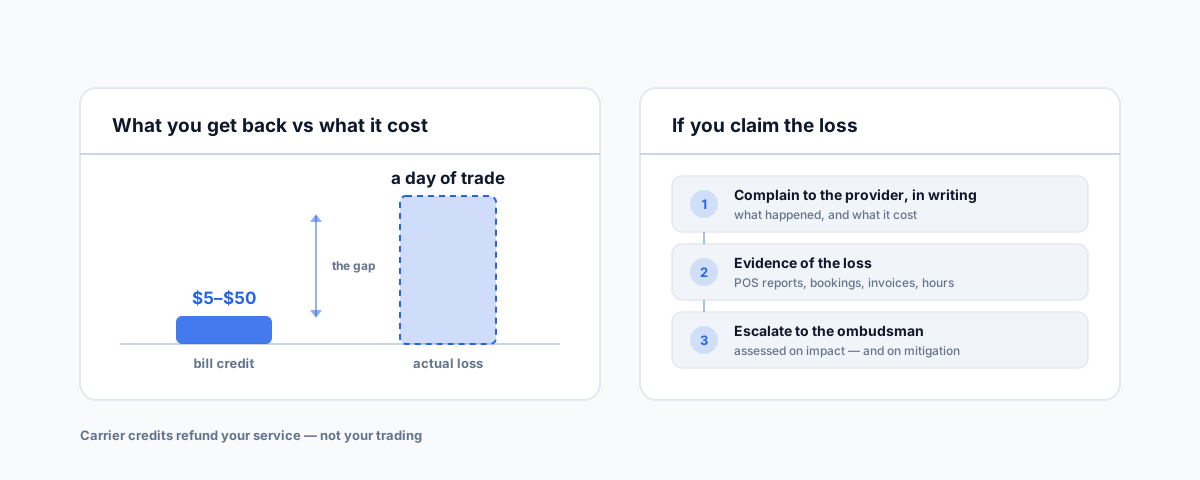
What carriers pay after an outage is, almost universally, a pro-rata refund of the service you paid for and didn't receive. It is not compensation for what the outage cost you. Those are different numbers by an order of magnitude or two.
Run it: a cafe turning over $2,000 on a normal weekday, down for the six hours across an afternoon and evening trade, is looking at a four-figure hole. A $5 credit — or $35, or $50 — is not addressing that loss. It's giving back a day of line rental. Both things can be reasonable at once: the carrier is refunding what you were billed for, and you are still substantially out of pocket, and the credit was never designed to close that gap.
Which means the practical decision is a small one. Asking takes ten minutes and gets you a modest credit, so ask. But don't build a recovery plan around it, and don't let the credit stand in for the harder conversation about why one carrier's bad afternoon could cost you a day's trade.
The Australian Version of the Same Question
T-Mobile customers in Australia are a rounding error, so the direct relevance is limited — but the mechanics here are close enough to be worth spelling out, and the last twelve months have given Australian businesses plenty of practice.
The starting point is that mobile outages carry no automatic compensation. The Customer Service Guarantee administered by the ACMA sets timeframes for connecting and repairing services and requires automatic payment when a telco misses them — but it applies to standard telephone (fixed-line) services, and mass outages are among the situations where a telco doesn't have to meet the standard. The ACMA's own guidance on mobile outages is explicit that carriers may not have to compensate customers when a mass outage occurs.
So what you're actually working with is:
- Your contract. Some plans allow a refund or rebate for major outages you didn't cause. Worth reading before you ring anyone.
- Goodwill credits. Same as the T-Mobile situation — discretionary, granted on request, sized to your bill rather than your loss. Telstra has run a dedicated business compensation line after past outages.
- Australian Consumer Law guarantees. These sit alongside your contract and can't be contracted out of, and they're the basis on which a claim for actual loss is argued rather than a goodwill credit.
How a Real Claim Works
If the loss is large enough to be worth pursuing beyond a credit, the path is the same regardless of provider:
- Complain to the provider first, in writing. The ombudsman won't take a complaint you haven't given the telco a chance to resolve. Say what happened, how it affected the business, and what it cost — with numbers.
- Bring evidence of the loss. POS and terminal reports for the outage window compared against equivalent trading days, cancelled bookings, invoices you couldn't issue, staff hours paid for work that couldn't happen. Assertions don't survive assessment; records do.
- Escalate to the ombudsman if the provider's answer isn't good enough. The Telecommunications Industry Ombudsman handles complaints from small businesses as well as consumers, and can make binding decisions on amounts up to $100,000 — though the vast majority of outage claims land nowhere near that.
The Clause Most People Miss
Here's the part that catches businesses out. When the TIO assesses a compensation claim, it looks at whether the telco breached its obligations, at the impact on you — and at what steps you took to protect your own interests and minimise the loss.
That last one has teeth. If the outage cost you a day of trade because a single carrier was the only path to your payments, your phones, and your customers, "we had no alternative" is not a neutral fact in the assessment. It's a question about mitigation, and the answer affects what you recover.
Which lands in the same place the last three outage posts did, from a different direction. The redundancy work — a second network path for payments, a phone system that isn't tied to one mobile carrier, a backup channel customers already know about — is usually framed as protecting your trading. It also happens to be the thing that makes a compensation claim defensible if you ever need to make one. The Telstra July outage and Verizon's two 2026 outages posts cover what those second paths look like in practice.
What To Do This Week
Whether or not you were affected by any specific outage, three things are worth doing while this is fresh:
- Ask for the credit if you were affected and haven't. It's small, it's yours, and it costs a phone call.
- Write down what an outage actually costs you — one number, hourly, based on real trading data. It makes every future decision about redundancy and every future claim much faster.
- Check you can produce the evidence. If your POS can't easily export a trading comparison for an arbitrary six-hour window, find that out now rather than mid-claim.
Getting Help
The honest summary is that compensation after a carrier outage is a modest refund, not a remedy — and the only reliable way to reduce what an outage costs is to make sure it can't take everything down at once. Our Small Business IT Support service maps where your payments, phones, and connectivity all funnel through a single provider, and builds the second path before you're the one adding up a day of lost trade.