
19 August 2026
How to Automate Rent Collection as an Independent Landlord: The Part You Can't Automate Decides the Rest
You can't compel a tenant onto your preferred payment method — NSW, Victoria and Queensland all guarantee the renter's choice, and NSW bans requiring a rent app outright. So the automation worth building is detection and reconciliation, not collection. How to set that up as a self-managing landlord.
Most self-managing landlords describe their rent collection as automated. Press on it and the description usually comes apart the same way: the tenant set up a recurring transfer when they moved in, and on the third of the month you open your banking app to check it landed.
That's not automation. That's a standing instruction sitting on someone else's account, plus a manual verification step you've moved into your own head. The money moving was never the hard part — it has been a solved problem since BPAY. The hard part is knowing, without looking, that it didn't move.
This post is about building the version that actually holds. It's written for owners self-managing one to five properties without an agent, and it starts with the constraint that most guides on this topic skip entirely — the one that determines what you're allowed to automate in the first place.
The Constraint That Comes First
Here's the thing that reorders everything else: you don't get to choose how your tenant pays you. They do.
This isn't a matter of goodwill or negotiation. It's written into residential tenancy law in every state that has updated it recently, and the three largest are consistent on the principle even where the wording differs:
- New South Wales requires landlords and agents to offer approved electronic bank transfer (EFT, direct debit, BPAY) and Centrepay, fee-free, and to let the tenant pay by whichever standard method they choose — and to let them switch methods at any point in the tenancy. See how and when to pay rent for the full list.
- Victoria requires at least one payment method the renter can use without paying a fee, plus Centrepay and a form of electronic funds transfer. Critically, any change to how rent is paid must be agreed between both parties — you can't switch a sitting tenant onto a new system by announcement.
- Queensland requires at least two payment options, one of which must be reasonably accessible and must not exceed reasonable transaction costs. Queensland goes further and requires you to disclose any financial benefit you receive if the tenant uses a particular method.
Then there's the provision that ends a whole category of plan. Since 19 May 2025, NSW has been explicit that tenants cannot be required to use a third-party app or any specified service to pay their rent or meet any other obligation — even if the app is free to them. You may offer it. You may not require it.
So the strategy a lot of landlord software implicitly sells you — sign up, invite your tenant, they pay through the platform, everything downstream is automatic — is not a strategy you can rely on. It works if the tenant agrees. If they'd rather keep their existing bank transfer, that's their right, and your automation has to survive it.
Which means the collection layer is the one part of this you have the least control over. Build there and you're building on someone else's consent. Build everywhere else and it doesn't matter how they pay.
Four Layers, And You Only Control Three
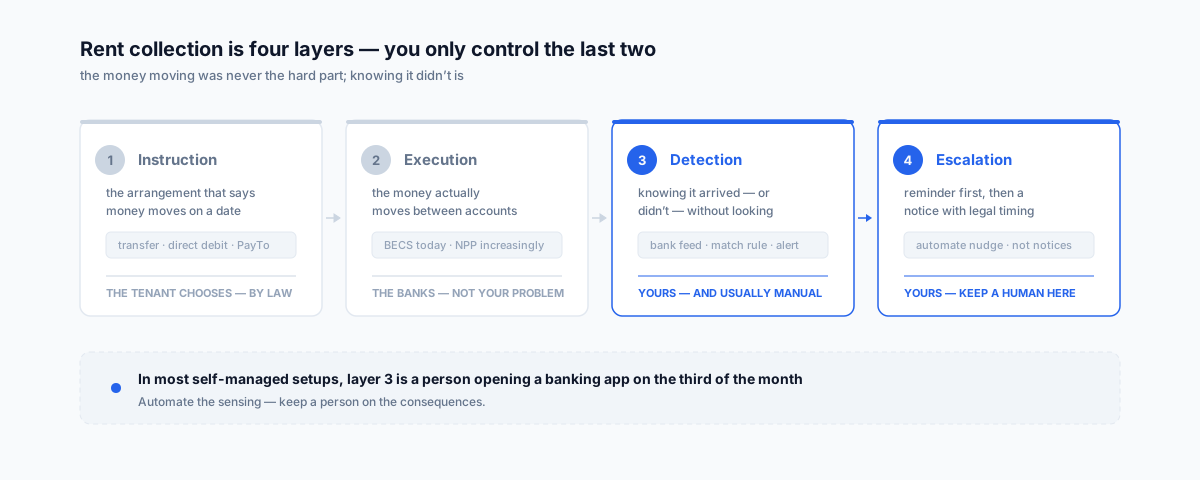
It helps to break "rent collection" into what it actually is:
- Instruction — the arrangement that says money should move on a date. A tenant's recurring transfer, a direct debit authority, a PayTo agreement, a Centrepay deduction.
- Execution — the money actually moving. Bank rails. Not your problem, and not something you can meaningfully improve.
- Detection — you knowing whether execution matched instruction, without checking. This is where almost every DIY setup has a person standing in the loop.
- Escalation — what happens when it didn't. Reminder, arrears notice, breach notice, each with its own timing and service requirements.
Layer one is negotiated, not imposed. Layer two is the banks'. Layers three and four are entirely yours, they're where the actual labour lives, and they're the ones nobody automates because the money usually does arrive and the problem stays invisible until it isn't.
Push Versus Pull, Honestly
The distinction still matters, just not as much as vendors imply.
Push is the tenant instructing their bank to send you money — a recurring transfer or a manual payment each period. The mandate lives with them. They can change or cancel it without telling you, and the first you'll know is a missing deposit. It costs nothing, needs no setup on your side, and is what most tenants default to.
Pull is you instructing their bank to take money — direct debit under a signed authority, or a PayTo agreement authorised in their banking app. The mandate lives with you. Missed payments surface as a failed debit with a reason code, which is genuinely better information than silence.
Pull sounds strictly superior, and for the detection layer it is. But it comes with obligations people underestimate: you become the party responsible for debiting the correct amount on the correct day, for handling dishonour fees fairly, for stopping cleanly at the end of a tenancy, and for getting a rent increase reflected correctly and only after proper notice. Debit the wrong amount and you haven't just made an accounting error — you've taken money you weren't entitled to, from someone who is going to notice immediately.
And you still can't insist on it. A tenant who declines direct debit is exercising a right, not being difficult.
On PayTo specifically: it's the New Payments Platform's modern replacement for direct debit, with the authorisation visible and cancellable inside the payer's own banking app. The RBA describes it as giving payers more control while giving billers real-time confirmation — which is exactly the detection improvement a landlord wants. The practical catch is availability: whether you can originate PayTo agreements depends on your bank or payment provider offering it to a customer of your size, and many don't offer it to individuals at all.
Worth knowing but not worth acting on yet: the industry does intend to retire BECS, the ageing batch system that direct debit and direct credit run on, in favour of the NPP. But AusPayNet has removed the previously flagged June 2030 target date pending a clearer roadmap, citing low member confidence in migrating direct debits by then. Direct debit is not going away on a timetable you need to plan around. Just don't build anything on the assumption that BECS is permanent either.
Building The Detection Layer
This is the part that pays for itself, and you can do most of it without buying anything.
Open a dedicated account per property. One account, one property, nothing else touching it. This single habit does more than any software: a balance that should change by exactly one predictable amount on exactly one predictable day is trivially easy to check, and unambiguous to reconcile. Mixing rent from three properties and your own salary into one account is what makes every later step hard.
Give each tenancy a unique payment reference and put it in the agreement. Not the tenant's surname — a fixed code. Surnames collide, get abbreviated by banking apps, and change. A reference that never varies is what lets any downstream rule match a deposit to a tenancy with certainty.
Use PayID for the receiving account. It removes the BSB-and-account-number transcription error, which is a real cause of "I paid it" disputes where the tenant genuinely did pay it — to someone else.
Set a bank alert for the absence, not the presence. Most banking apps will notify you on a deposit. That's the wrong signal; you'll stop reading it by month three. What you want is to hear from the system only when the expected credit hasn't appeared by a set date. Few consumer banking apps do this natively, which is precisely why it's the piece worth building rather than buying.
Push the feed into accounting software. A bank feed into Xero, QuickBooks or a dedicated landlord tool with a rule matching your payment reference turns each deposit into a categorised, property-tagged transaction with no typing. It also gives you the arrears view as a by-product — an unmatched period is visible rather than remembered.
If you've been comparing tools already, our guide to property management software for landlords in Australia covers the local DIY tier, and what "direct deposit" actually means in Australian rental software untangles the US terminology that makes this category confusing to shop for. If US products keep surfacing in your search results, Baselane vs TurboTenant explains why neither is usable here.
The Escalation Layer Is Where Automation Gets Risky
Detection can be fully automatic. Escalation should not be, and this is where enthusiasm causes damage.
A friendly reminder a few days after a missed payment is safe to send automatically, and it resolves most cases — the majority of missed rent is a changed pay cycle or a bank error, not a dispute. Automate that one freely.
Everything past it deserves a human. Arrears notices and breach notices have prescribed content, prescribed timing, and prescribed methods of service that vary by state, and a notice sent early, worded loosely, or served the wrong way is worse than no notice: it's invalid, it resets your clock, and it can be evidence against you later. An automated system firing a formal breach notice on day one because a tenant's employer moved payday is not efficiency.
The rule that holds up: automate the sensing, keep a person on the consequences.
What You Cannot Automate At All
Worth naming, because these get mistaken for software gaps:
- Bond lodgement. Bonds go to the state authority — the RTBA in Victoria, Rental Bonds Online in NSW, the RTA in Queensland — within statutory timeframes. Holding a bond in your own account is an offence, and no rent tool does this step for you.
- Rent increases. Minimum notice periods and frequency limits are set by state law. Your system can remind you of the earliest permissible date; it cannot shorten it.
- Rent receipts and records. Victoria requires a receipt within five business days of a request and rent records kept for at least 12 months. Your bank statement isn't a compliant receipt.
- The condition report and entry notices. Unrelated to money, and the most common source of disputes that money automation can't help with.
The Tax Side, Which Automation Can Quietly Break
One trap specific to automating collection: the ATO requires you to declare gross rent — the full amount you received or became entitled to, before fees or expenses are taken out. If money reaches you net of a platform fee or a processing charge, your bank deposit no longer equals your assessable income, and if you reconcile straight from the deposit you will understate income and lose the deduction for the fee at the same time.
Any tool that nets anything before it reaches you needs to produce a statement showing the gross figure and the deduction separately, and that statement is what you reconcile against. The ATO's guidance on records for rental properties sets out what to keep and for how long — five years from the date you lodge, in a form that's readable and reproducible.
This is also the honest argument for the boring per-property bank account. When the deposit is the gross rent and nothing has been skimmed in transit, your reconciliation is a one-to-one match and your year-end is an export rather than an investigation.
A Setup That Actually Works
Putting it together, for a landlord with one to five properties:
- One bank account per property, PayID enabled, unique payment reference per tenancy written into the agreement.
- Offer the full set of fee-free methods your state requires, and let the tenant pick. Offer direct debit or PayTo as an option, and take it if they want it — but don't design around getting it.
- Bank feed into accounting software, with a rule matching each reference to the right property.
- An alert on the absence of the expected credit, not its arrival.
- An automatic friendly reminder at a set number of days late — and a calendar entry, not a trigger, for anything formal beyond that.
- Statements filed monthly, gross figures preserved, five years retained.
Nothing here requires a landlord platform. A platform can be worth it once the number of tenancies makes the reconciliation tedious, or once you want inspections, maintenance requests and documents in the same place. But the structure above is what a platform is doing underneath, and if you don't have it, adding software mostly gives you a tidier view of a mess.
Getting Help
The gap in almost every self-managed setup is the same one, and it's not the payment: it's that the only monitoring in the system is a person remembering to look. That works until the month you're away, distracted, or simply assume it landed because it always does — and arrears are much easier to resolve in week one than in week six.
Building the sensing layer is a genuine automation job: a bank feed, a matching rule, a scheduled check for the credit that should have arrived, and a notification when it didn't. It's not a large build, and it doesn't require your tenant to agree to anything or change how they pay. Our Workflow Automation service can set that up against the accounts and tools you already use, so the follow-up starts on time without you being the trigger.