
6 August 2026
Content Approval Workflows for Creative Agencies: Best Practices That Stop Round Seven
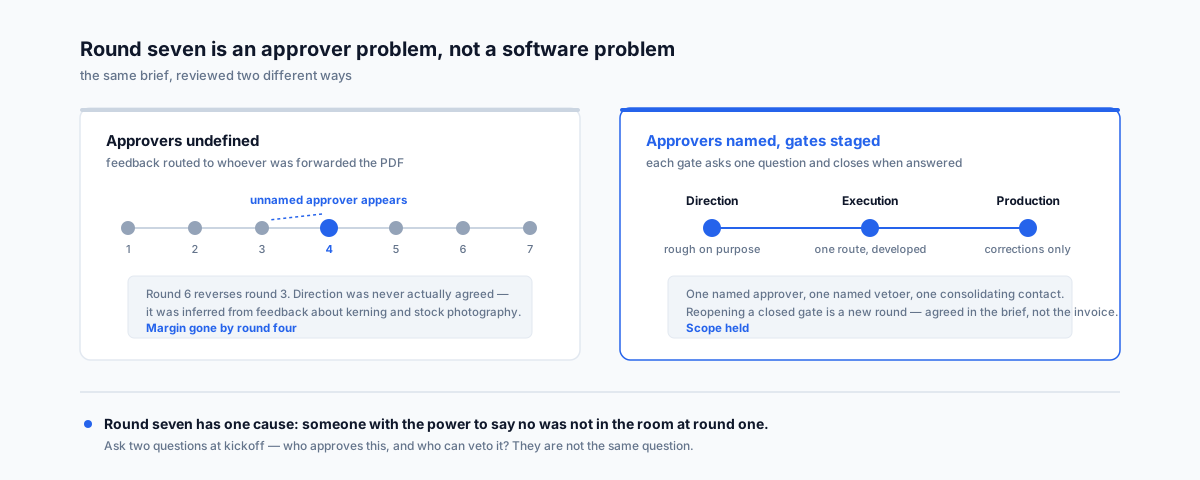
Round seven happens because someone with veto power turned up at round four. The approval practices that actually reduce revision cycles, why deemed-approval clauses now sit inside a penalty regime in Australia, and the liability question most agencies get backwards.
Every agency has a version of the same story. Round seven of a campaign that was scoped for two. The change requested in round six directly reverses the change requested in round three, and both came from the same client. Somebody senior who has never been in a single meeting has appeared with opinions about the logo size. The margin on the job evaporated somewhere around round four and nobody noticed until invoicing.
The instinct is to blame the client, and then to go looking for software. Neither is quite right. The client isn't being unreasonable by their own lights — they're routing feedback through a process that was never defined, so every new voice is as valid as the last. And software will make a broken approval process faster without making it shorter.
Round seven is almost always caused by one thing: someone with the power to say no was not in the room at round one. Most of what follows is about fixing that, and about the two Australian complications nobody writes up.
Why Creative Approvals Break Differently
It's worth being precise about why this category is harder than approving an invoice, because the fix follows from the difference.
- There's no correct answer. A supplier bill either matches the purchase order or it doesn't. A headline is a judgement, and judgements don't converge on their own — they converge when someone is empowered to end the discussion.
- The approver list is discovered, not declared. Finance approval chains are defined by delegation authority. Creative approval chains are defined by whoever the client's project manager happens to forward the PDF to.
- Feedback arrives in fragments. Three emails, a phone call, and a comment in a meeting, often contradicting each other, often from different people who haven't spoken.
- Late changes are cheapest for the person requesting them and most expensive for you. The incentives are structurally misaligned, and no amount of goodwill fixes an incentive problem.
Name Every Approver Before The First Concept
This is the highest-leverage thing on the list and it costs nothing.
Before any creative work starts, get a written answer to two questions: who approves this, and who can veto it? They are not the same question, and the second one is where agencies get hurt. The marketing manager approves. The founder vetoes. If you only asked about approval, the founder arrives at round four and you start again.
Ask it explicitly, in the kickoff, in writing:
- Who signs off on creative direction?
- Who signs off on final assets?
- Is there anyone above them who reviews this before it goes live — legal, compliance, a founder, a franchisor, a board?
- Who is the single person consolidating feedback on your side?
Then put the answer in the project brief and repeat it back in the first status email. When someone new appears at round four, you have a document that says they weren't on the list — which is not a weapon to use against a client, but it is the basis for a calm conversation about whether this is a new round or an included one.
Approve The Direction Before The Execution
The second-biggest cause of round seven is showing polished work when you needed a decision about direction.
Clients respond to what's in front of them. Show three finished layouts and you'll get feedback on kerning and stock photography — not on whether the strategic direction is right. Then in round five, when someone finally engages with the direction, everything downstream is wasted.
Stage the approvals so each gate asks one question:
- Gate 1 — direction. Territory, tone, message hierarchy. Deliberately rough. Sketches, moodboards, wireframes, headline options in plain text.
- Gate 2 — execution. One direction, developed. Layout, copy, imagery.
- Gate 3 — production. Final files, proofing, technical checks. Changes here are corrections, not opinions.
Write into the brief that each gate is closed once approved, and that reopening an earlier gate is a new round. The point of naming the gates isn't bureaucracy — it's that "we approved the direction in gate one" is a sentence you can say later, and "you said you liked it" is not.
One Voice: Consolidate Feedback Client-Side
Make it the client's job to resolve their own internal disagreements before the feedback reaches you.
This sounds like a boundary you can't set. It's actually the thing good clients want to be asked, because the alternative is that your team becomes the unpaid arbitrator of an internal disagreement between their marketing manager and their sales director. That's not a job you can do — you don't have the standing — and every hour spent attempting it is unbilled.
The practical form: one named person collates all feedback into a single response per round, by an agreed date, with conflicts already resolved. If two stakeholders disagree, that's resolved on their side before it reaches you. Contradictory feedback in a single round gets one question back — "these two changes conflict, which would you like?" — and the clock stops until it's answered.
Feedback Belongs On The Work, Not In An Email Thread
"Can we make the header bit at the top a bit punchier?" is a real piece of feedback that costs an hour of guessing. An annotation pinned to the actual header saying "punchier" costs thirty seconds and no ambiguity.
Move feedback onto the artefact itself — annotations on a proof, timestamped comments on a video, a comment pinned to a frame. Three things improve at once: ambiguity drops, the feedback is automatically attributed to a person, and you get a record of who asked for what without maintaining one by hand.
It also solves the version problem, which is quietly expensive. Emailing PDFs guarantees that someone eventually reviews version 3 while everyone else is discussing version 5. A proofing tool with a single live link means the URL always points at current, and comparing versions is a feature rather than a favour.
Make Rounds Contractual — Then Actually Enforce Them
Most agency contracts already specify included revision rounds. Most agencies don't enforce them, which makes the clause worse than useless — it establishes that the number is negotiable.
Two changes make it work:
- Define what a round is. A round is one consolidated set of feedback, delivered by the named contact, by the agreed date. Three separate emails over a week is three rounds, or it's one round that hasn't started yet — pick one and say so in the contract.
- Flag the boundary before you cross it, not on the invoice. When feedback arrives that would start round three of two, say so in writing before doing the work, with the cost. Clients almost always approve it. What they don't accept is discovering it after the fact, and that's the conversation that damages relationships.
Scope creep in creative work is nearly always approval creep wearing a different hat. Fixing the approval process fixes most of the scope problem without a single difficult conversation about money.
Deemed Approval Clauses, And The Australian Catch
The standard fix for clients who go quiet is a deemed-approval clause: if the client doesn't respond within three business days, the work is taken as approved and the project proceeds.
These are useful and worth having. But if you're an Australian agency using a standard-form contract, that clause now sits inside a regime with real teeth.
Since 9 November 2023, proposing, using or relying on an unfair contract term in a standard form contract is banned, with penalties attached — and the small business threshold widened to businesses with fewer than 100 employees or under $10 million annual turnover, which covers a large share of agency clients. The ACCC's guidance on contracts and unfair contract terms sets out how the test works. Maximum penalties for a company run to the greater of three times the benefit obtained or 30 per cent of adjusted turnover during the breach period; for an individual, $2.5 million.
That doesn't make deemed approval unfair on its face. What matters is whether the term goes further than reasonably necessary to protect your legitimate interests, and whether it causes a significant imbalance. In practice:
- A short, clearly-notified deemed approval window on a scheduled deliverable — defensible. You have a legitimate interest in not having a booked production slot stranded.
- Deemed approval that also waives all liability for errors the client never got to see — much harder to defend. That's the imbalance the regime is aimed at.
- A clause the client can't reciprocate and wasn't given a chance to negotiate — a standard-form contract, which is precisely the category the law covers.
The practical version: keep the clause, keep the window realistic, send an explicit reminder before it expires, and don't attach a liability waiver to silence. Get your standard agreement reviewed by someone who does this for a living — this is a paragraph in a blog post, not advice on your contract.
Creative Approval Is Not Compliance Sign-Off
Two different approvals get collapsed into one, and it causes trouble in both directions.
Creative approval says: this is the work we want. Compliance sign-off says: we can lawfully publish this claim. The second one is not a design opinion, and the person doing the first is usually not qualified to do the second.
Here's the part most agencies have backwards. There's a widespread belief that the agency carries the legal exposure for a client's claims — the "we made the ad, so we're on the hook" assumption. The ACCC and ASIC actually ran that argument, bringing cases in the early 2000s aimed at holding advertising agencies responsible as gatekeepers for misleading advertisements made for clients. The courts rejected it, and regulators have not seriously pursued that theory since.
Primary liability under the Australian Consumer Law sits with the advertiser making the claim. The ACCC's advertising and promotions guidance is written at businesses about their own claims for that reason. Australia's self-regulatory system points the same way — the AANA Code of Ethics applies to the advertiser or marketer who has reasonable control over the communication, and Ad Standards complaints are determined against the advertiser.
Two caveats that matter. Accessorial liability still exists — an agency knowingly concerned in misleading conduct is not insulated by any of the above, so "the client told us to say it" stops working the moment you knew the claim was false. And your contract can allocate liability regardless of what the general law says, which is where most agency exposure actually lives.
So the correct posture isn't defensive fear, and it isn't indifference. It's this: substantiation is the client's job, and getting them to do it in writing is yours. Any claim that's comparative, quantified, or superlative — cheapest, fastest, number one, clinically proven, Australian made — goes back to the client for written substantiation before it goes to production. Not because the ACCC is coming for you, but because when a claim turns out to be unsupportable, the argument about who authorised it is one you want to have with a document in your hand.
Keep The Approval Record — It's Your Indemnity, Not Your Filing
Which leads to the thing agencies under-value most.
The approval trail is not administrative housekeeping. It is the evidence that decides two arguments you will eventually have: whether a round was included or additional, and who authorised a claim that turned out to be wrong. Both arguments are won or lost on whether you can produce a dated record showing a named person approved a specific version.
Practically:
- Approval must name a version. "Approved" against a live link that has since changed is worth very little. "Approved v4, 12 August" is worth a lot.
- Approval must name a person. Not "the client approved" — a person, with a timestamp.
- Written beats verbal, always. Verbal approval in a meeting is fine as long as it's followed by an email that says what was approved, and nobody objects.
- Export it before you need it. If the record only exists inside a subscription you might not renew, you don't own it. Check what the export looks like on the way in, not on the way out.
For anything requiring genuine signature rather than approval — statements of work, variations, usage rights — that's a separate mechanism. We compared DocuSign, Adobe Sign and the eSignature feature built into Microsoft 365 if that's the gap.
The Tools, Briefly
Tooling is the last step, not the first — but once the process is defined, the right tool enforces it for free.
For creative work specifically, you want online proofing rather than a general approval platform: annotation directly on the asset, version comparison, timestamped comments on video, and a review link that works for a client with no account and no training.
- Filestage — Free, Starter at $199/month and Business at $329/month, all with unlimited reviewers and 10 team members, expandable in bundles of five.
- Ziflow — free Personal tier, then $199/month and $329/month billed annually, with 15 and 20 included users respectively and, again, unlimited external reviewers.
- Frame.io — video-first and the natural fit for anyone already living in Adobe tools.
Note what's happened to the pricing shape: both major proofing tools now include unlimited external reviewers at every paid tier, and several comparison sites still quote per-seat figures that are out of date. That matters more than the headline price for an agency, because your reviewer count is your entire client base and it changes every month. If a tool you're evaluating still charges per reviewer, that's now the outlier — and a reason to keep looking.
If your approval problem extends past creative into invoices, spend or people, that's a different category with different tools — our roundup of nine approval workflow software solutions sorts those out.
What To Change This Week
You don't need to redesign the whole process. In order of return on effort:
- Add the two questions to your kickoff template — who approves, who can veto. Nothing else on this list pays back faster.
- Split your next project into direction, execution and production gates, and say so in the brief.
- Define a round in writing — one consolidated set of feedback, one named contact, one date.
- Move one live project onto a proofing link instead of emailed PDFs, and see what happens to the ambiguity.
- Send the boundary email the next time round three starts, before you do the work rather than after.
- Check your deemed-approval clause against the unfair contract terms regime, and get the agreement reviewed properly.
Getting Help
The agencies that escape round seven aren't the ones with the best software. They're the ones where the approval process is written down, agreed at kickoff, and enforced politely and consistently by everyone on the team — which is a management problem first and a systems problem second.
Where systems help is in making the right behaviour the easy one: the review link that's always current, the annotation that attributes itself, the record that assembles without anyone maintaining it. That's usually also the point at which the rest of the studio's admin — briefs, timesheets, status reporting — turns out to be held together by manual habit too, which tends to show up alongside the other signs a tech stack has been outgrown.
Our Workflow Automation service maps how work actually moves through your studio, wires the approval stages into the tools you already use, and makes the audit trail a by-product rather than a chore.