
21 July 2026
Turning Live Chat Into a Lead Channel: Routing, Qualifying, and Following Up Without Losing the Conversation
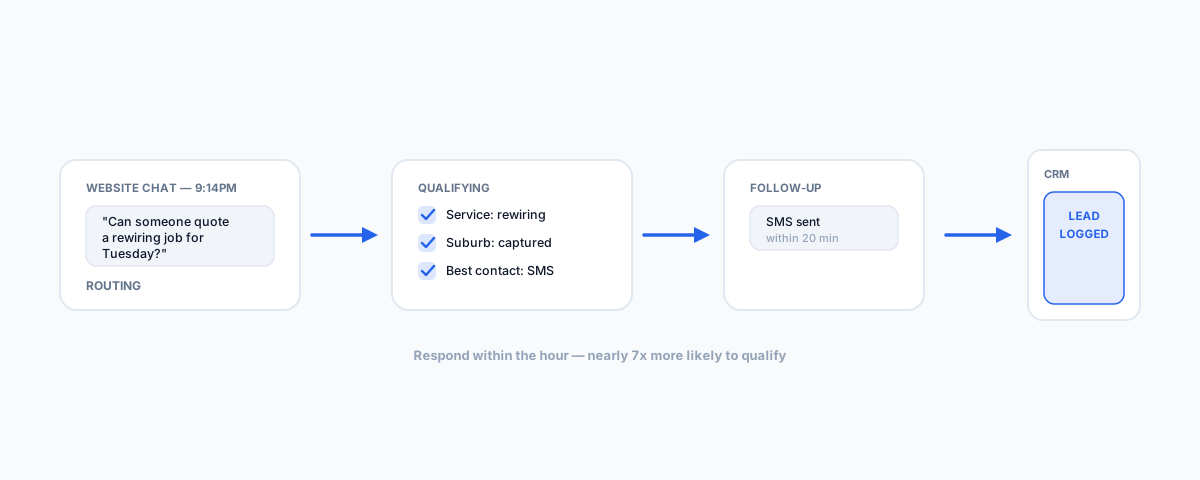
A landmark Harvard Business Review study found companies that responded to a lead within an hour were far more likely to qualify it than those who waited even a day. Most small business chat widgets are set up to fail that test. The three layers — routing, qualifying, and follow-up — that turn a chat bubble into an actual sales channel.
A visitor lands on your website at 9pm, opens the chat bubble, and asks a real question about a real job they want done. Nobody's online. The message sits in a queue until Monday morning, and by then either they've bought from whoever did answer, or the urgency that brought them to your site in the first place has simply passed. This is the most common way a live chat widget fails a business — not because the software is bad, but because a chat bubble was installed as a box-ticking exercise rather than set up as an actual lead channel, with nobody explicitly responsible for what happens after the message lands.
Why Speed Is the Whole Game
The foundational research on this is older than the chat widgets themselves but has never stopped being true. A landmark study published in Harvard Business Review, based on an audit of over 2,000 companies' actual response times to test leads, found that firms contacting a lead within an hour were nearly seven times more likely to qualify it than those that waited even 24 hours — and the gap only widens the longer the delay runs. The mechanism is not complicated: a customer messaging you about a problem is usually also messaging, or about to message, whoever else shows up in their search. Whoever replies first with something specific and useful is very often the one who gets the job, and that dynamic hasn't changed since the study was published — if anything, instant messaging has made the comparison window shorter, not longer.
Layer One: Routing
The first failure point is simple — who actually gets notified when a chat comes in, and when. Most small business chat tools (Intercom, Zendesk, Tidio, and similar) support routing rules: business-hours chats go to whoever's rostered on live chat that day, rather than a shared inbox nobody's specifically watching, and after-hours or weekend messages either trigger an SMS or app alert to an on-call person or hand off cleanly to a bot that captures contact details and the nature of the enquiry for first-thing-Monday follow-up. The point of routing isn't speed alone, it's accountability — a message with no assigned owner is a message that quietly becomes nobody's job.
Layer Two: Qualifying
A generic "someone will be with you shortly" does nothing to move a conversation forward, and a human replying cold to "hi, are you free to quote a job" has to ask the same three questions a bot could have already collected. A short qualifying flow — what service, roughly when, suburb or location, and the best way to reach them if the chat goes idle — means whoever picks up the conversation next, whether that's an hour or a day later, opens with something specific instead of starting from zero. This is also where a chat tool earns its keep over a plain contact form: the back-and-forth of a chat interface tolerates a few quick qualifying questions in a way a long form usually doesn't.
Layer Three: Follow-Up
This is the layer almost every small business skips, and it's the one the Harvard Business Review data is really about — because a chat that ends with "thanks, someone will be in touch" is not follow-up, it's a hope. The lead needs to land somewhere that survives the chat window closing: synced into a CRM (our guide to HubSpot for small business covers this end of the stack) with the qualifying details attached, not just a transcript nobody revisits. If the conversation went idle waiting on a reply, a follow-up message on a channel more persistent than chat — SMS or WhatsApp, covered in our guide to integrating WhatsApp and SMS into a business phone system — recovers a real share of conversations that would otherwise just end when the browser tab closes. For businesses already running follow-up automation elsewhere, our guide to automating Jobber with Zapier and its API shows the same pattern applied to quotes and jobs rather than chat.
What Good Looks Like End to End
Put together, the three layers are: a rule that gets the right person notified immediately during business hours and captures a qualified, followable lead outside them; a short set of qualifying questions so the first real reply isn't generic; and a CRM or automation step that guarantees the lead is followed up on a persistent channel even if the original chat window is long closed. None of this requires enterprise tooling — most of it is configuration inside the chat platform and CRM you likely already have, done deliberately instead of left on defaults.
Getting Help
Most of the value in live chat gets lost between the message arriving and someone actually replying with something useful — and that gap is almost always a configuration and process problem, not a tooling one. Our Workflow Automation service sets up routing, qualifying flows, and CRM handoff so a chat message becomes a tracked lead instead of a transcript nobody reopens. The data on response speed hasn't changed in over a decade — what's changed is how cheap it now is to actually act on it.