
5 August 2026
The August 2026 Spectrum Outage: When Your Internet Is the Single Point of Failure
Spectrum went down across the US on 3 August, and so did its status page, its apps and its website — so customers couldn't even confirm the problem wasn't theirs. Why a broadband outage takes out an entire premises at once, why a provider bundle isn't redundancy, and what fixed-site failover actually costs.
On the evening of Monday 3 August 2026, Spectrum customers across the United States lost internet and TV. Reports on Downdetector spiked to around 4.3 times the normal level for that hour, passed 5,000 that evening, and by early Tuesday had climbed past 14,000 in a single hour, according to reporting on the outage. Charter Communications, which owns Spectrum, confirmed engineers were working on it. It did not say what had broken, and it did not say when it would be fixed.
That much is a fairly ordinary outage story, and this site has now covered three of them — Telstra in July, Verizon's two in 2026, and T-Mobile's compensation aftermath. All three were mobile networks. This one is not, and the difference matters more than it looks.
What Actually Happened
The reports started around 7:40pm Eastern Time and kept climbing overnight. Clusters showed up in Tampa, Milwaukee and Rochester, but the pattern was scattered rather than regional — which is the first clue that this wasn't a cut cable somewhere.
A caveat on those numbers, because it's worth being straight about the evidence: Downdetector counts are self-reported by users, not measured from the network. They are good at telling you when something started and roughly how big it feels. They are not a customer count, and nobody outside Charter knows the real one.
The Detail Most Coverage Skipped
Here is the part that actually deserves attention. The Spectrum TV app, the My Spectrum app and the company's website went down at the same time as the service itself.
That combination rules out most of the boring explanations. A severed fibre in one metro doesn't take down a national website. A failed node in your street doesn't break an app running on a phone connected to a mobile network. When the service, the apps and the web presence all fail together, the failure is sitting somewhere in the platform layer — authentication, DNS, a core routing change, something central.
It also creates a specific and underrated problem for the customer. The tool you use to check whether it's the provider's fault was part of the outage. So a business owner standing in a shop at 8pm with dead EFTPOS and a dead booking system had no way to confirm the problem wasn't their own gear — and quite reasonably spent the next half hour power-cycling a modem that was working perfectly.
Two Failure Modes, One Lesson
Set the August event next to the other Spectrum outage worth remembering, because together they close off the two obvious fixes.
On 15 June 2025, vandals cut fibre lines in Van Nuys, Los Angeles. Thirteen cables were severed, containing more than 2,600 individual fibres. Roughly 50,000 residential customers and more than 500 business customers lost service for up to 30 hours. The damage reached emergency dispatch and 911 communications for local fire and police, hospitals, courts, financial institutions and cell towers that depended on that fibre for backhaul. Charter deemed it an act of domestic terrorism; the LAPD investigated it as felony vandalism, and offered a reward for information. No arrests were announced.
So: one national, software-shaped, invisible failure, and one hyper-local, physical, brutally simple one. Note what each defeats.
- A second premises doesn't help with August. If the failure is central, every site you run on that provider goes down together.
- A second account with the same provider doesn't help with Van Nuys. Two services delivered down the same street, through the same conduit, are one service with two invoices.
- Waiting for an announcement doesn't help with either. In August, Charter gave no cause and no ETA. In Van Nuys, the answer took days and didn't restore anything.
Why a Broadband Outage Hits Differently to a Mobile One
When a mobile network fails, staff lose calls and data on their handsets, and card terminals on mobile backhaul stop working. It's bad, but it's distributed — some people are on Wi-Fi, some are on another carrier, and the business usually retains a few working paths by accident.
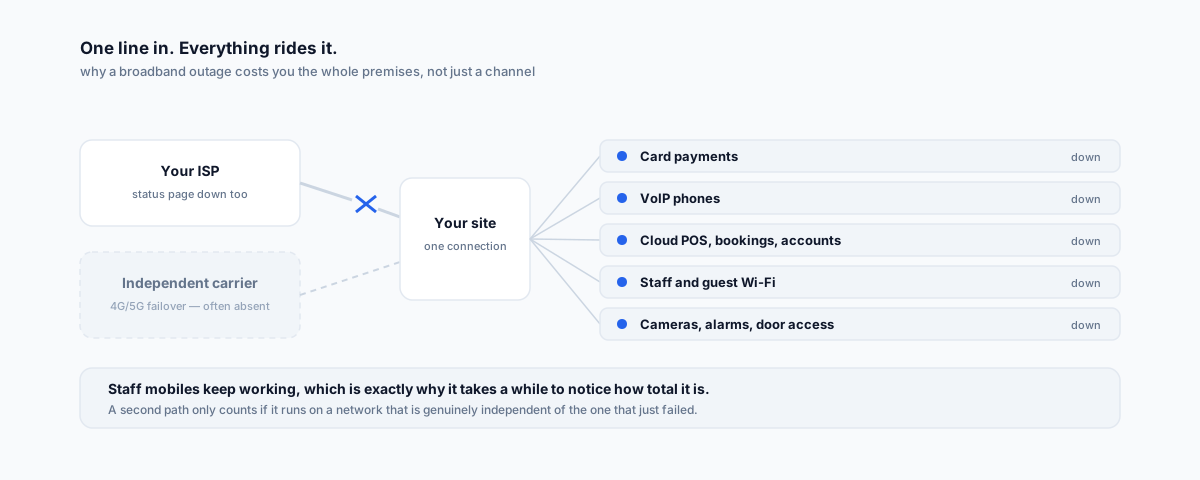
When the fixed line into a premises fails, everything at that address goes at once:
- Card payments, if the terminal is on the shop's internet rather than its own mobile connection.
- The phones, if you've moved to VoIP — which most businesses have. A hosted phone system is just another application riding the same line.
- Anything cloud-based, which is now nearly everything: the point-of-sale, the booking calendar, the accounting file, the roster, the inventory lookup.
- Wi-Fi for customers and staff, so people burn their own mobile data as an ad-hoc workaround.
- Cameras, alarms and door access, which quietly stop recording or reporting and which nobody notices until later.
The mobile outage costs you some channels. The broadband outage costs you the premises. And because staff mobiles keep working normally throughout, it often takes a while for anyone to grasp how total it is.
Why the Provider Bundle Isn't Redundancy
This one is specific to Spectrum but the pattern is everywhere, so it's worth spelling out.
Spectrum sells mobile service alongside internet. On paper, a business with Spectrum Internet and Spectrum Mobile has two connections on two different technologies. In practice, Spectrum Mobile is a mobile virtual network operator — it doesn't own a mobile network, it resells capacity on Verizon's. So that "second path" is one vendor relationship, one bill, one support queue, and a mobile leg riding the network that went down twice in 2026 on its own account.
The Australian version of the same trap: a bundled mobile broadband backup from the same telco that supplies your fixed line, or a "4G failover" service where the SIM inside the router belongs to the retailer whose fixed network just failed. Sometimes those are genuinely separate networks underneath. Often they aren't. The only way to know is to ask which network the backup SIM actually runs on and get the answer in writing before you rely on it.
Telling "Them" From "You" in Five Minutes
Because the status page can be part of the outage, it's worth having a method that doesn't depend on the provider. This takes about five minutes and it is worth writing on a card near the modem.
- Check from a phone on mobile data, with Wi-Fi turned off. If a site loads there but not on the shop Wi-Fi, the internet exists and your line or your gear is the problem. If nothing works from either, it isn't your gear.
- Look at the modem's lights before touching anything. A modem that has lost sync or lost signal from the street looks different to one that's online but not passing traffic. Photograph it — it's the first thing support will ask about, and by then you'll have rebooted it.
- Check whether one device or all devices are affected. One dead laptop is not an outage.
- Reboot exactly once, and only after the checks above. Rebooting first destroys the evidence and fixes almost nothing that's actually an outage.
- Check an independent source, not just the provider's app. Downdetector, a local community page, or simply ringing the business next door on the same street.
- Then stop debugging. Once you've established it's the provider, further troubleshooting is wasted time. Switch to the fallback plan and log the fault so there's a record for later.
What Fixed-Site Failover Actually Looks Like
Redundancy for a fixed location is a different piece of equipment to redundancy for a phone, and it's cheaper than most people assume.
- A router with 4G/5G failover and a SIM from a different carrier. The router holds a mobile connection in reserve and cuts over automatically, usually within seconds. This is the single highest-value change for most small sites. The rule that makes it real: the backup SIM must be on a network that is genuinely independent of the fixed provider.
- Payment terminals that carry their own connectivity. A terminal with its own SIM keeps taking money when the shop's line is dead. Many businesses already have this and don't know it — worth checking, because it changes the entire cost of an outage.
- A phone system that can divert without your internet working. Hosted voice is only as available as your line. Confirm you can redirect the main number to a mobile from a portal you can reach on a phone, and that someone other than the owner knows how.
- An offline mode you have actually tested. Some point-of-sale systems can keep trading and sync later; some cannot. Some payment terminals will store-and-forward within limits and some will decline everything. Find out which yours does before the day it matters, not during.
- A written fallback that isn't stored in the cloud. The plan, the support numbers and the account details need to exist on paper or on a phone, because the file share is behind the connection that just died.
There's a sizing question attached, and it's the same one as always: work out what an hour of downtime actually costs your business, then spend accordingly. A café doing counter trade has a concrete number. A consultancy that can work offline for a morning does not need the same investment. Our notes on network setup for a small office or venue go further into what the hardware side of this looks like.
The Australian Version: Less Protection, Not More
If you're reading this from Australia and assuming local regulation would treat an internet outage more seriously, it's worth correcting that.
The Customer Service Guarantee, administered by the ACMA, sets minimum timeframes for connecting services, repairing faults and keeping appointments, with compensation payable when a telco misses them. But it covers voice telephony faults. Internet faults sit outside it. So the protection that exists for a dead landline does not extend to a dead broadband service, even though the broadband service is the one your entire business now runs on. The CSG also contains exemptions for mass service disruptions — the exact scenario a national outage creates.
Two more things worth knowing:
- Your nbn service level agreement isn't yours. The SLA sits between nbn and your retail provider. Your rights are whatever is in your contract with the retailer, which is usually considerably less.
- Escalation still exists, it's just slower. Complain to the provider in writing first, then escalate to the Telecommunications Industry Ombudsman, which handles small business complaints. As covered in the T-Mobile compensation post, what you'll recover is usually a pro-rata refund of line rental rather than anything resembling a trading loss — and the assessment will look at what steps you took to limit the damage yourself.
That last point is the one that connects back to everything above. "We had no alternative connection" is not a neutral statement in a compensation assessment. It's an answer to a question about mitigation.
What To Do This Week
Three things, none of which require a purchase decision today:
- Find out what your card terminal is actually connected to. If it's on the shop Wi-Fi, that's the single biggest exposure and often the easiest to change.
- Ask your provider which network your failover SIM runs on, if you have one. If the answer is the same company that supplies your fixed line, you have one path, not two.
- Write down one number: what an hour offline costs you. Every subsequent decision — whether to buy a failover router, whether to pursue a claim, how hard to push a provider — gets faster once that number exists.
Getting Help
The August outage is a useful reminder precisely because Charter never explained it. You don't get to plan around the specific cause of the next failure, because you won't know it while it's happening and you may never know it afterwards. What you can plan around is the shape: one line into one building, carrying payments, phones and every cloud application at once, with no second path. Our Small Business IT Support service works through where your connectivity actually converges — including the failover you think you have but don't — and builds the second path before you're the one standing in a shop at 8pm, rebooting a modem that was never the problem.